Maria had been running a busy taco truck for two years when she decided to add a fried item — churros, to start, maybe loaded fries down the road. She bought a countertop electric fryer rated at 1,800 watts from a big-box restaurant supply site, plugged it into her truck’s existing 30-amp shore power circuit, and called it done. Six weeks later, she’d tripped her breaker seventeen times, received a health-department notice about missing grease-collection documentation, and burned through two batches of oil faster than expected because the unit couldn’t recover temperature (get back up to frying temp after cold food drops in) fast enough during a lunch rush. The fryer wasn’t a bad fryer. It was the wrong fryer for her build, her power setup, and her local code requirements.
If you’re anywhere in the process of speccing out or upgrading a deep fryer for a food truck — maybe you’ve got a build under contract, maybe you’re mid-negotiation with a fabricator on hood specs — this guide is for you. We’re going to walk through the three variables that actually determine whether a fryer works in a mobile kitchen: oil capacity, electrical draw (wattage), and ventilation requirements. We’ll name the trade-offs directly and give you clear if/then decision rules so you can walk into your next conversation with numbers, not guesses.
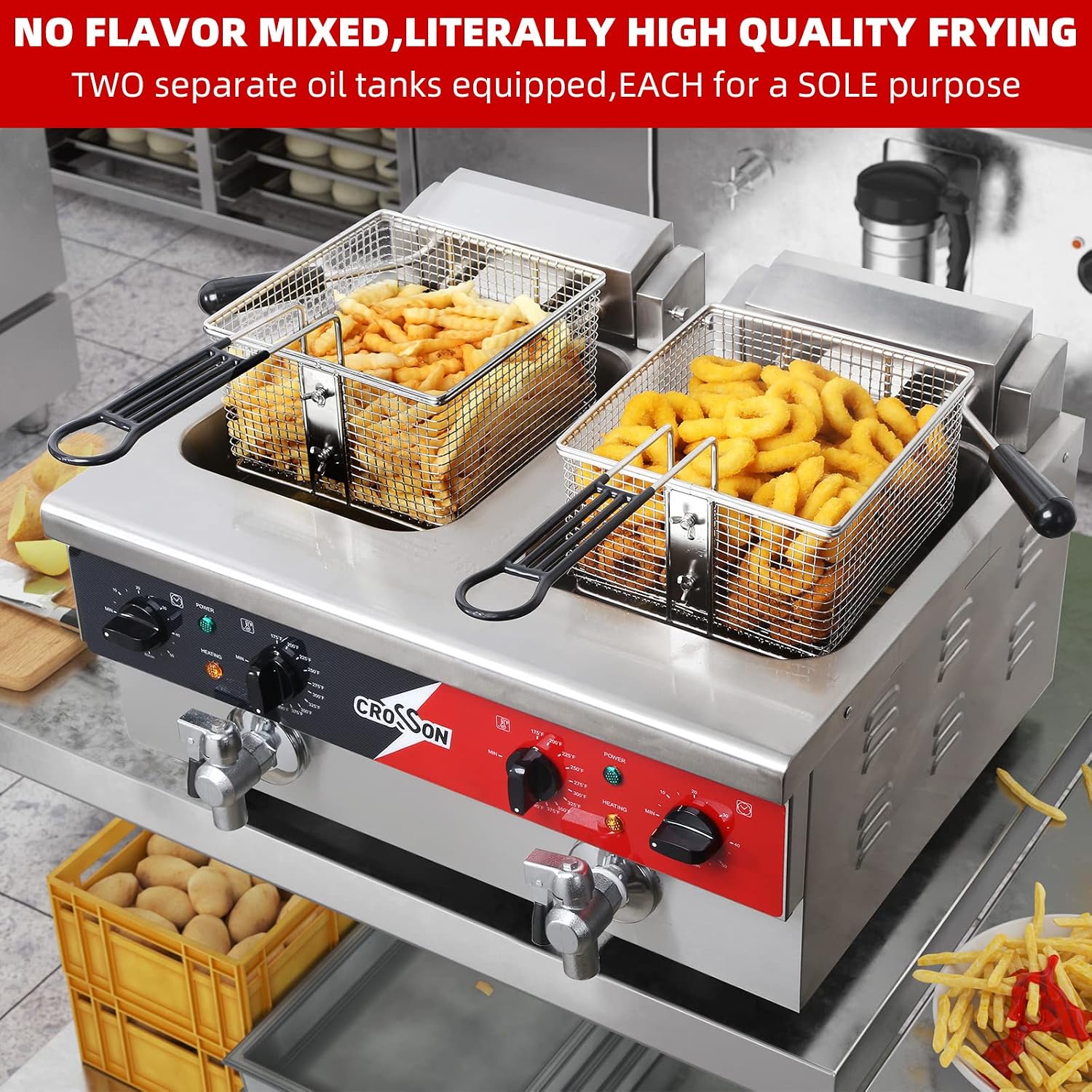
| EDITOR'S PICK[CROSSON 12L Dual Tank Counterto…](https://www.amazon.com/dp/B0BRW6JPC3?tag=greenflower20-20) | Mid-tier[CROSSON ETL Listed Dual Tank 26…](https://www.amazon.com/dp/B0BFGGMNL2?tag=greenflower20-20) | Budget pick[VEVOR Outdoor Propane Deep Fryer](https://www.amazon.com/dp/B0DQS87Q44?tag=greenflower20-20) | |
|---|---|---|---|
| Oil Capacity | 12L | 26Lbs | 16 Qt |
| Power Source | Electric, 120V | Electric, 120V | Propane |
| Wattage | 3600W | 3600W | — |
| Drain Included | ✓ | — | — |
| Basket Material | — | Solid | Removable |
| Tank Count | Dual | Dual | Double |
| Price | $589.00 | $374.00 | $143.99 |
| See on Amazon → | See on Amazon → | See on Amazon → |
Oil Capacity: More Isn’t Always Better in a Tight Build
Oil capacity is measured in pounds of oil (for most commercial fryers) or, for countertop electric units, sometimes in liters. A standard countertop commercial electric fryer holds roughly 15–25 lbs of oil. A full-size floor model runs 50 lbs and up. That difference matters enormously in a food truck, for three reasons: weight, recovery time, and oil-cost management.
Weight is a load constraint, not a preference. Every food truck has a gross vehicle weight rating (GVWR) — the maximum safe loaded weight the chassis is rated to carry. A gallon of frying oil weighs about 7.5 lbs. A 50-lb oil capacity fryer holds roughly 6.5 gallons of oil. Add the fryer’s own steel body weight (floor models often run 100–150 lbs empty), plus mounting hardware and full product load, and you’re looking at 250–300 lbs allocated to one piece of equipment. Operators building on a lighter trailer chassis (14–16 ft) frequently hit GVWR friction before they hit kitchen capacity. Food Truck Empire’s equipment sizing guide specifically flags fryer weight as one of the most commonly under-budgeted load items in compact builds.
Recovery time is a throughput constraint. Recovery time is how long the fryer takes to return to its set frying temperature after you drop a basket of cold food in. A unit with higher wattage-to-oil-volume ratio recovers faster. A 3,500-watt unit with 15 lbs of oil will recover in roughly 90 seconds. The same 3,500 watts heating 40 lbs of oil might take four minutes. During a lunch rush where you’re pulling baskets every two minutes, a slow recovery rate is a revenue ceiling — you physically can’t fry fast enough to keep up. QSR Magazine’s coverage of fryer program economics has noted that operators underestimate recovery time impact on throughput more than almost any other equipment variable.
Oil cost and waste are real P&L variables. Larger oil volumes mean higher initial oil cost, longer heat-up times (more propane or electricity burned before you’re frying), and more oil to dispose of properly at end of service. If your menu only runs one or two fried items, a 15–20 lb countertop fryer is frequently the better economic choice even if your power supply could handle more. The SBA’s food truck business guidance on operational cost modeling emphasizes that consumable inputs — oil being a primary example — should be sized to actual production volume, not aspirational capacity.
By the Numbers: Fryer Size vs. Trade-Offs
| Fryer Size | Typical Oil Capacity | Typical Wattage | Best Fit |
|---|---|---|---|
| Countertop light-duty | 10–15 lbs | 1,600–1,800W | 1–2 fried items, low volume |
| Countertop commercial | 15–25 lbs | 3,500–5,000W | 2–4 items, medium rush |
| Compact floor model | 30–50 lbs | 5,500–11,000W | High-volume or multi-basket menu |
Wattage, Circuits, and the Generator Math Nobody Does Until It’s Too Late
This is where most first-time fryer buyers make their expensive mistake. Wattage (the rate at which a device draws electrical power) determines whether your fryer will run on your truck’s existing electrical system — or blow it up trying.
A 30-amp, 240-volt shore power connection, which is the most common single-circuit hookup on smaller food trucks, delivers a maximum of 7,200 watts. That sounds like a lot until you realize a single commercial countertop fryer at 5,000 watts is already consuming 69% of that circuit’s capacity — before your steam table, reach-in refrigerator compressor, POS tablet, and lighting pull their share. If you’re running a generator rather than shore power, you’re working with a generator that has its own wattage ceiling, typically 6,500–12,000 watts for mid-range food truck generators, and a starting-load surge capacity that spikes above running wattage every time the compressor kicks on.
The practical math works like this: add up the running wattage of every piece of electrical equipment in your truck. Then add 20% as a safety buffer (electrical codes and most generator manufacturers recommend running no more than 80% of rated capacity continuously). What’s left is your fryer budget. For many mid-size food truck builds running standard support equipment, that available budget lands between 3,000–5,000 watts — which maps directly to the countertop commercial fryer tier.
Propane is a legitimate alternative, and it changes the math significantly. A propane fryer removes the electrical load problem entirely, shifting it to BTU (British Thermal Unit) output and ventilation requirements instead. Propane fryers in the 80,000–100,000 BTU range are common in mobile applications and offer faster recovery time than most equivalently priced electric units. The tradeoffs: propane tanks take up floor and exterior space, require DOT-compliant mounting and fuel-line installation, and add a layer of fire-suppression inspection complexity that some local health departments scrutinize closely. Restaurant Business Online’s reporting on mobile food unit ventilation compliance has noted that propane fryers in food trucks trigger more frequent hood-suppression inspection requirements than electric models in several major metro markets as of 2025–2026.
If your build is still in the fabrication contract phase, this is the moment to specify whether you want electric or propane fryer rough-in — because the hood, suppression system, and electrical sub-panel are all designed around that choice. Changing it post-build is a five-figure retrofit in most cases.
Ventilation: The Constraint That Overrules Everything Else
You can solve for oil capacity. You can solve for wattage. Ventilation is the variable that has the hardest real-world ceiling because it’s governed by physical dimensions, local health codes, and fire suppression standards simultaneously.
A commercial deep fryer — any commercial deep fryer — must operate under a Type 1 hood. A Type 1 hood is a ventilation system specifically designed to capture grease-laden air and combustion byproducts. It includes a grease trap (a filter system that catches airborne grease particles before they enter the exhaust duct), an exhaust duct, a make-up air system (fresh air that replaces what the exhaust pulls out), and a fire suppression system (typically an automatic wet chemical system that discharges over the fryer if temperatures exceed a set threshold). This is not optional. NSF International’s NSF/ANSI 4 standard for commercial cooking equipment and virtually every state and county health department code require Type 1 hood coverage for any open-vat fryer.
In a food truck, hood dimensions are fixed at build time. The hood’s CFM rating (cubic feet per minute — how much air it moves per minute) must be matched to the heat and grease output of the equipment underneath it. A hood rated for 600 CFM that’s serving a 100,000 BTU propane fryer is undersized; the grease-laden air won’t clear properly, which creates both a fire risk and a health code violation. Your fabricator should be calculating hood CFM against fryer BTU or wattage output as a standard part of the kitchen layout — if they’re not, ask directly.
The clearance problem in compact builds. Standard NSF-compliant hood installation requires a minimum clearance between the hood’s lower edge and the cooking surface. For most countertop fryer configurations, that’s 18–24 inches of vertical clearance minimum (requirements vary by jurisdiction and equipment type — confirm with your local authority having jurisdiction, or AHJ). In a truck with a 7-foot interior ceiling height, after accounting for the hood body, duct work, and suppression system hardware, you may find your available countertop height is constrained to a narrower range than you expected. This is one reason why experienced fabricators at shops like Prestige Food Trucks or Cruising Kitchens build equipment layouts around hood geometry first and fill in equipment second — not the other way around.
Fire suppression system service costs are a recurring expense operators routinely underestimate. Most jurisdictions require suppression systems to be inspected and certified semi-annually. Inspection costs typically run $150–$400 per visit depending on market and system complexity, per operator reports aggregated across food truck community forums and confirmed in Food Truck Empire’s operating cost breakdowns. Budget it.
The Decision Framework: If X, Then Y
If you’re making a fryer decision right now, here’s a plain-language summary of the decision rules this guide supports:
If your truck is on shore power under 50 amps and your electrical load audit leaves you fewer than 4,000 watts of headroom, go countertop electric in the 3,500W range and accept the throughput ceiling. Don’t overload your circuit to buy recovery speed you can’t safely sustain.
If your menu has more than four fried SKUs (menu items) or you’re doing high-volume event work, propane is the right path — but confirm your local AHJ’s suppression inspection frequency before you commit, and factor semi-annual inspection costs into your operating budget from day one.
If you’re still in the fabricator negotiation phase, specify fryer type (electric vs. propane) and BTU/wattage before hood dimensions are finalized. Hood geometry locks in the rest of the kitchen layout. Reversing that order is the most common — and most expensive — sequencing mistake in food truck builds.
If you’re upgrading an existing build, run a full electrical load audit before buying anything. The fryer that fits your menu may not fit your panel, and a panel upgrade in a completed build typically runs $800–$2,500 depending on the scope.
The fryer itself is almost never the problem. The mismatch between the fryer and the system it’s plugged into — electrical, ventilation, regulatory — is where builds go sideways. Get those three numbers right first, and the equipment choice becomes straightforward.