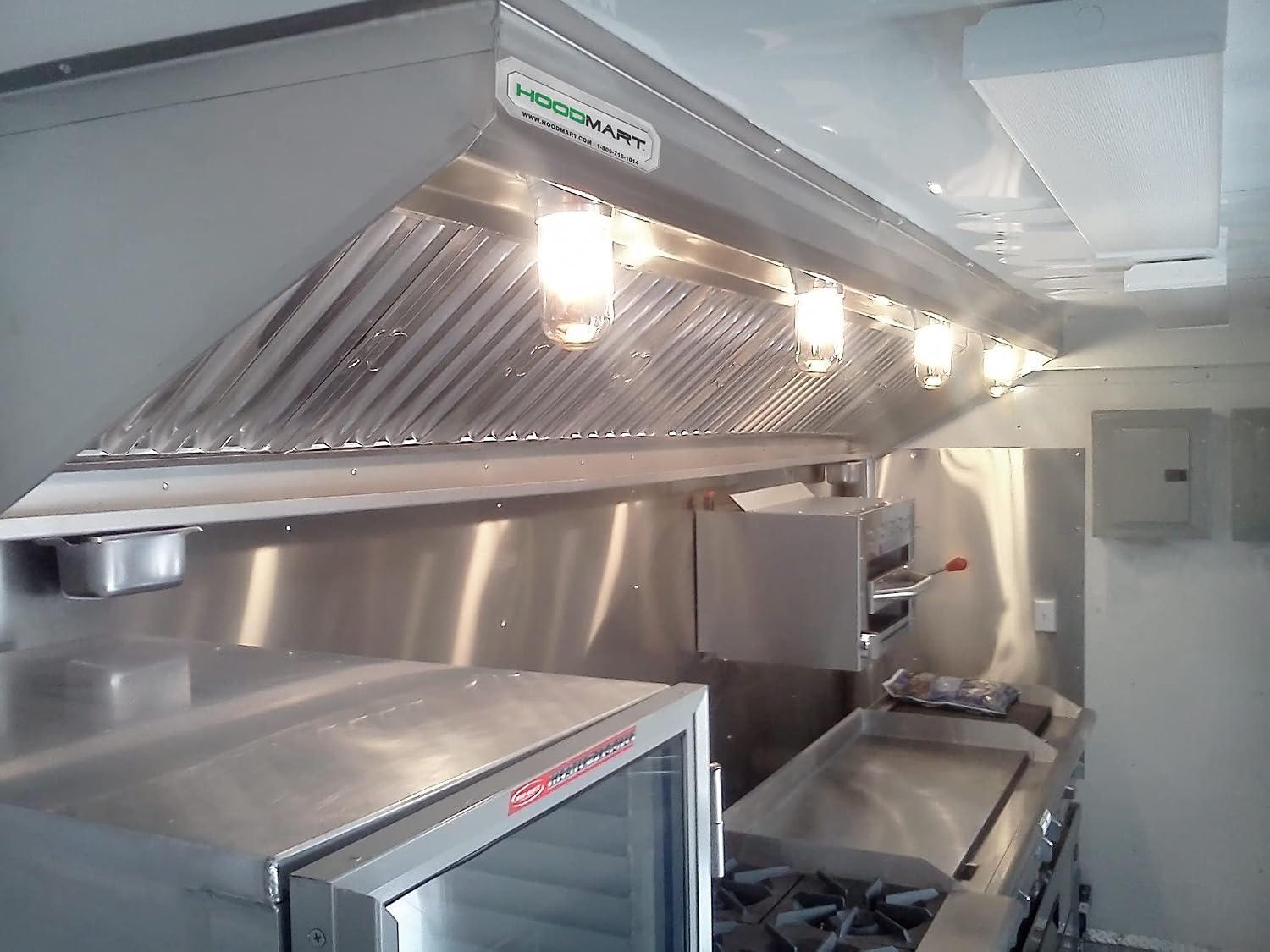
Maria had been running a Tex-Mex trailer for two years when she decided to upgrade from a single flat-top to a full commercial range with a char-broiler. She bought a used hood — the dimensions looked right, the price was right — and had it installed two weeks before her county health inspection. The inspector walked in, looked at the hood, and asked for the fire suppression certificate. Maria handed him the paperwork. He handed it back: the suppression system was rated for her old equipment load, not the new one. She lost her operating permit for 23 days while a certified technician re-engineered the system.
That kind of delay — measured in lost revenue, not just paperwork — is almost always preventable. Your exhaust hood system (the ventilation canopy above your cooking equipment, plus the fan that moves air out and the fire suppression that protects the space) is the single most scrutinized assembly at permit time. This article will walk you through the three numbers that matter most — CFM, BTUs, and UL listing — show you the math behind sizing decisions, and give you a plain-language picture of what health and fire inspectors are actually checking when they come through your door.
The Core Trio: CFM, BTU Load, and UL Listing
CFM: How Much Air Your Hood Has to Move
CFM stands for cubic feet per minute — it’s the volume of air your exhaust fan pulls out of the cooking space every minute. A fan that’s undersized leaves smoke, grease vapor, and heat trapped inside the truck. A fan that’s dramatically oversized creates negative pressure problems: doors that won’t seal, pilot lights that blow out, and makeup air (the fresh air that replaces what you exhaust) that becomes expensive to condition.
The industry starting point for sizing comes from NFPA 96, the National Fire Protection Association’s standard for commercial cooking ventilation. NFPA 96 doesn’t prescribe a single CFM number — it requires that the hood capture and contain the cooking effluent (grease-laden vapor and combustion byproducts) from all equipment beneath it. In practice, most fabricators and mechanical engineers use a duty-based formula:
- Light duty (sandwich press, steam table, warming equipment): 100–200 CFM per linear foot of hood
- Medium duty (fryers, griddles, standard ranges): 200–300 CFM per linear foot
- Heavy duty (char-broilers, woks, open-flame ranges): 300–500 CFM per linear foot
A 6-foot hood over a char-broiler and two-burner fryer battery — a common mid-range food truck setup — would therefore need somewhere between 1,800 and 3,000 CFM depending on the specific equipment. That’s a wide range, and the right answer lives in a detailed equipment schedule, not a rule of thumb.
BTU Load: The Number That Actually Drives Suppression Sizing
Where CFM governs airflow, BTU load (British Thermal Units per hour — the heat output of your cooking equipment) governs fire suppression sizing. Every suppression system listed under UL 300 (Underwriters Laboratories’ fire-testing standard for restaurant cooking protection) carries a maximum protected BTU rating. If you add equipment after installation — as Maria did — you can exceed that rating without realizing it.
The calculation is straightforward: add up the manufacturer-rated BTU/hr for every piece of cooking equipment under the hood. A commercial char-broiler might run 90,000 BTU/hr. A 40-lb fryer adds another 70,000–80,000. A standard six-burner range contributes roughly 150,000. A modest food truck cooking suite can easily reach 300,000–400,000 BTU/hr total, which pushes you into the upper tier of suppression system ratings.
UL 300 Listing: The Certification Your Inspector Is Looking For
When your fire marshal or health inspector asks for suppression documentation, they are almost always asking for a UL 300-listed system — not UL 300A (an older, superseded standard), not a dry-chemical system from a non-listed manufacturer, and not a residential kitchen hood. The UL 300 listing means the suppression agent (a wet chemical designed to react with hot cooking grease and form a soapy foam barrier) has been independently tested against real commercial cooking scenarios.
Per Restaurant Business Online’s coverage of mobile kitchen compliance, the most common suppression brands you’ll encounter in food truck builds are Ansul (owned by Johnson Controls) and Amerex, both of which manufacture UL 300-listed systems. “Ansul-ready” — a term you’ll see in fabricator specs — means the hood and plenum (the internal grease-collection chamber) have been built with the correct nozzle placement points, detection link brackets, and tank mounting provisions to accept an Ansul R-102 or similar system. It does not mean the suppression system is already installed. That’s a critical distinction when you’re reviewing a fabricator proposal.
By the Numbers
| Equipment Type | Typical BTU/hr | Recommended CFM/linear ft |
|---|---|---|
| Flat-top griddle (standard) | 30,000–60,000 | 200–250 |
| Commercial fryer (40 lb) | 70,000–80,000 | 250–300 |
| Char-broiler (36”) | 80,000–110,000 | 350–500 |
| Six-burner range | 130,000–160,000 | 200–300 |
Sources: published equipment specifications from commercial manufacturers; NFPA 96 duty-classification guidance.
What Health Inspectors and Fire Marshals Are Actually Checking
Here’s where operators often get tripped up: the health inspector and the fire marshal are running parallel but different checklists, and your hood system has to satisfy both.
The Fire Marshal’s Checklist
The fire marshal (or fire prevention bureau, depending on your jurisdiction) cares about:
- UL 300 listing documentation — a certificate from the installing contractor showing the system model, installation date, and the BTU/equipment load it was sized for
- Six-month inspection tags — suppression systems require biannual inspection by a licensed contractor; expired tags are an immediate flag
- Ansul or wet-chemical agent type — dry chemical systems are increasingly rejected for grease-application environments; some jurisdictions have banned them outright for commercial cooking
- Fusible links and detection coverage — every nozzle position must correspond to a thermal detection point, and the detection links must be clean (grease-caked links can fail to trip)
- Hood-to-equipment alignment — the suppression nozzles must be aimed at the actual hazard zones of the installed equipment, not a generic position
As noted in NFPA 96’s equipment-change provisions, any modification to the cooking suite — adding, removing, or repositioning equipment — requires re-evaluation of the suppression system. This is not optional, and it’s exactly what caught Maria.
The Health Inspector’s Checklist
Your local health department, operating under the jurisdiction of your state’s food code (most states have adopted some version of the FDA Food Code), cares about different things from the same hood:
- Grease containment — the hood’s grease filters (typically Type I baffle filters) must be present, properly seated, and cleanable; mesh filters are banned in most jurisdictions for high-grease applications
- Drip tray and grease collection cup — must be accessible, removable, and not overflowing
- Cleaning records — some jurisdictions require a hood-cleaning log showing professional degreasing at intervals based on cooking volume (quarterly for high-volume fryer operations, semi-annually for lighter use)
- Makeup air — inspectors are increasingly checking that your truck has a documented makeup air source; a sealed truck running a 2,000 CFM exhaust fan with no intake creates dangerous negative pressure and can backflow combustion gases from propane equipment
Food Truck Empire’s health inspection guide notes that grease filter condition is among the top five food truck violation categories nationwide, alongside handwashing station access and temperature logs. A hood that passes fire inspection can still generate a health violation if the filters are damaged or improperly sized for the opening.
The Makeup Air Problem Nobody Talks About in the Sales Pitch
Most fabricator proposals will spec out your exhaust system in detail and say very little about makeup air. Makeup air is the conditioned (or at minimum, filtered) fresh air that enters the truck to replace what the exhaust fan is removing. Without adequate makeup air:
- The exhaust fan works harder, shortens its lifespan, and still doesn’t capture effectively
- Negative pressure pulls unfiltered air in through every gap — door seals, service windows, generator penetrations
- In cold climates, unconditioned makeup air drops your interior temperature and affects food holding
- In some jurisdictions, the lack of a documented makeup air plan is a permit denial
The rule of thumb most mechanical engineers use is that makeup air should replace 80–90% of the exhaust volume. If you’re exhausting 2,000 CFM, you want roughly 1,600–1,800 CFM of makeup air supply. Some systems bring this in through a dedicated wall-mounted supply plenum; others use a short-circuit supply built into the hood canopy itself. Both approaches are legitimate — what matters is that it’s documented in your permit drawings.
Per QSR Magazine’s ventilation compliance coverage, the short-circuit supply design (where makeup air is introduced at the front face of the hood, just inside the capture zone) has become the preferred approach in trailer builds under 30 feet because it uses the available ceiling height more efficiently and avoids a separate HVAC penetration in the roof.
The “If X, Then Y” Decision Framework
You’re in the middle of a build decision or permit review right now. Here’s the clearest way to think about what you need:
If your cooking suite is under 200,000 BTU/hr total and limited to griddles and fryers: A standard Type I hood, medium-duty CFM sizing (200–300 CFM/linear foot), and an entry-tier UL 300 wet-chemical system (Ansul R-102 at its lower nozzle configuration, or Amerex equivalent) will satisfy most jurisdictions. Budget $3,500–$7,000 for the suppression system installed.
If your suite includes a char-broiler or exceeds 300,000 BTU/hr: You’re in heavy-duty territory. Expect 350–500 CFM per linear foot, a suppression system sized for the specific BTU load (not a standard off-the-shelf configuration), and a makeup air plan your fabricator has to document. Installed suppression costs commonly run $7,000–$14,000 at this tier.
If you’re adding equipment to an existing build: Stop before the equipment arrives. Have your suppression contractor re-evaluate the BTU load against your current system’s rating. If you’re adding more than 30,000–40,000 BTU/hr of new equipment, assume you’ll need a system upgrade or at minimum a re-certification visit. The cost of a suppression re-evaluation ($300–$600 in most markets) is insignificant compared to 23 days of lost permits.
If your fabricator spec sheet says “Ansul-ready” but doesn’t include a suppression line item: Ask specifically what is included and what isn’t. “Ansul-ready” prep work is not a suppression system. Get clarity in writing before you sign.
The hood system is not the most glamorous part of a food truck build — it doesn’t show up in the Instagram photos and nobody cheers when the baffle filters arrive. But it’s the one system that sits at the intersection of your fire permit, your health permit, and your operator liability. Getting it right before the inspector walks in is the entire game.