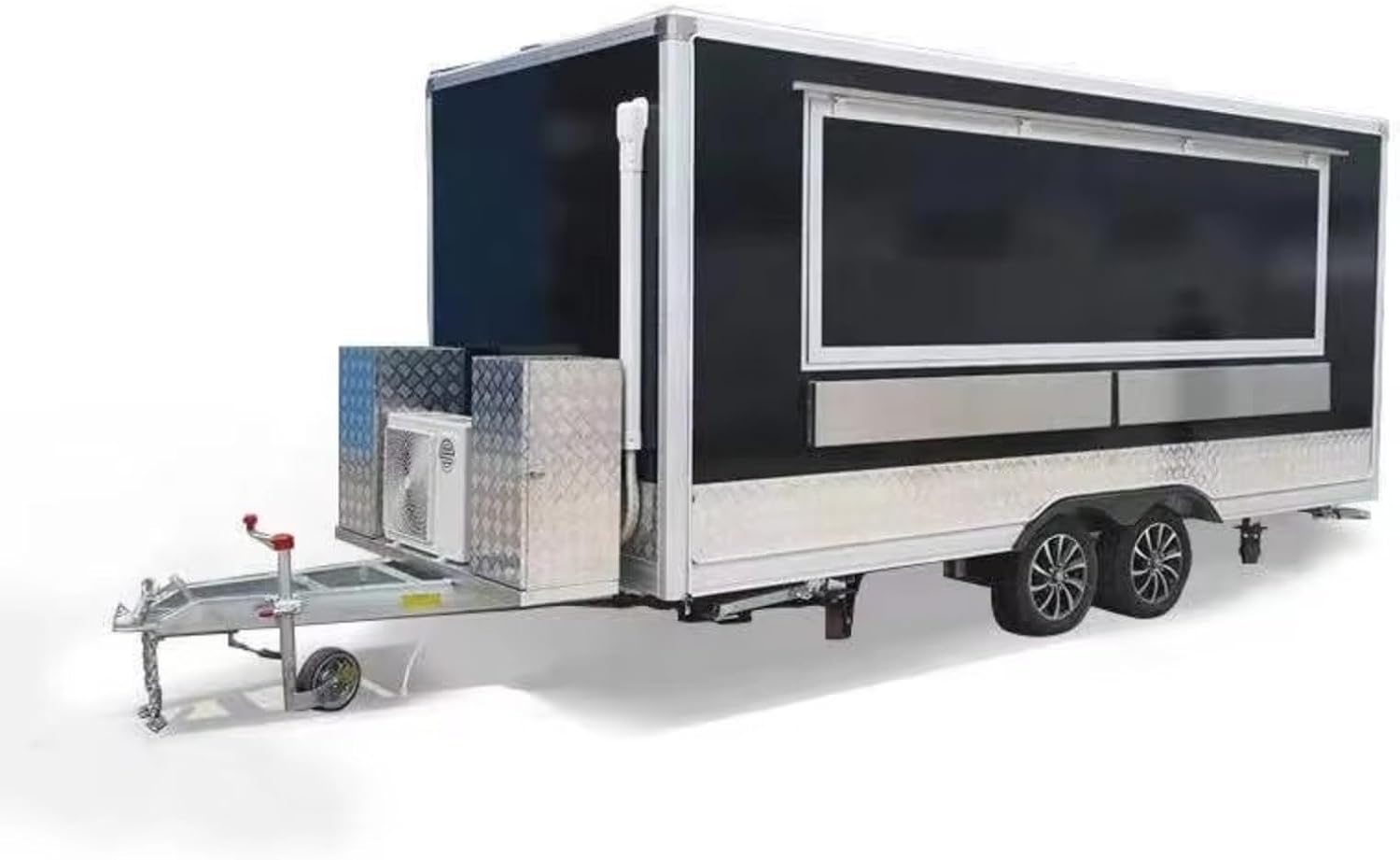
Marcus had been running a kettle-corn stand out of his garage for three summers when he decided it was time to go legit. He found what looked like the perfect listing — a gleaming, stainless-steel food trailer on Amazon, advertised as “fully equipped” and “turnkey ready,” priced at $14,500. It had a two-burner commercial range, a ventilation hood, and a serving window. He bought it. Six months later, he’d spent an additional $22,000 before he flipped the sign to OPEN for the first time.
Marcus’s story is common enough that it deserves a dedicated breakdown. A food trailer is a towed, non-motorized unit equipped for commercial food preparation — the trailer attaches to a pickup or SUV and stays parked at events or permitted locations. Turnkey is a sales term that, in theory, means “ready to operate the day it arrives.” In practice, the word does a lot of heavy lifting on product listings. This article will walk you through exactly what Amazon’s turnkey food trailer listings typically include, what they don’t, and how to build a realistic cost model before you commit.
What “Turnkey” Actually Means on a Marketplace Listing
When a fabricator uses “turnkey” in a contract, it usually means they are responsible for a defined scope — specified equipment, wiring, plumbing, and compliance signoffs — through to final inspection. When Amazon or a third-party marketplace seller uses it, it almost never means that. It means the trailer ships with some equipment already installed.
That distinction matters enormously. As Food Truck Empire’s cost guide notes, the average food trailer buyer who purchases through a marketplace listing rather than a direct-to-fabricator channel spends 40–60% of the unit purchase price on post-delivery modifications to reach health-department approval. That’s not a horror story — that’s the median.
Here’s what marketplace “turnkey” listings at the $10,000–$35,000 price range typically include:
Usually included:
- Bare trailer shell with axle(s), hitch, and running lights rated for road towing
- A serving window (often a single slide-out panel)
- Basic stainless-steel countertop surfaces
- One or two pieces of cooking equipment — commonly a flat-top griddle or a two-burner range
- A ventilation hood shell (not always ducted, and rarely fire-suppression equipped)
- Freshwater and gray-water tank rough-plumbing (tanks installed, but fittings and pump rarely included)
- Minimal or no electrical: sometimes a single 30-amp shore-power hookup, rarely a generator
Rarely included:
- NSF-certified (National Sanitation Foundation — a certification that equipment meets food-safety standards required by most health departments) handwashing sink
- Three-compartment sink (required by virtually every state for mobile food units)
- Fire suppression system on the hood
- Generator or generator compartment
- LP (liquid propane) tank and pressure-regulation plumbing
- Health department permit, commissary agreement, or any compliance documentation
- DOT (Department of Transportation) certification decal for interstate towing
The Restaurant Business Online piece on mobile food unit regulations flags that as of 2025–2026, at least 34 states have updated their mobile food unit codes to require three-compartment sinks and NSF-certified equipment as baseline for permitting — not optional upgrades. A trailer that ships without those items isn’t a “nearly ready” unit; it’s a shell.
The Real Cost Stack: Building the Full Number
Let’s do the math that the listing page doesn’t show you.
By the numbers — typical gap between Amazon sticker and permitted-ready cost (2026 market)
| Line Item | Sticker (Included) | Typical Add-On Cost |
|---|---|---|
| Base trailer + basic equipment | $14,500 | — |
| 3-compartment sink + handwash sink install | Not included | $1,800–$3,500 |
| Fire suppression system (Type I hood) | Hood shell only | $2,500–$5,000 |
| LP tank, regulator, and flex-line plumbing | Not included | $600–$1,200 |
| Generator or shore-power wiring upgrade | Not included | $2,000–$6,000 |
| Electrical panel, outlets, GFCI compliance | Minimal | $800–$2,500 |
| Permits, commissary fees (year one) | Not included | $1,500–$4,000 |
| Realistic permitted-ready total | $23,700–$36,700 |
These figures track consistently with what Food Truck Empire’s cost breakdown and Entrepreneur’s startup cost guide report for entry-to-mid tier trailer operators in 2025–2026. Your actual number will vary by state, county, and concept — a trailer running only pre-packaged goods faces fewer equipment requirements than a full hot-food operation.
The SBA’s business planning resources recommend treating equipment cost as a three-part number: acquisition, compliance modification, and first-year maintenance reserve. Most first-time buyers budget for only the first.
The Five Specific Gaps That Bite Buyers Hardest
1. The Hood Is Not the Fire Suppression System
A stainless-steel ventilation hood and a compliant fire suppression system are two different things. The hood moves air. The suppression system — a network of nozzles connected to a wet-chemical agent tank — is what most jurisdictions require before a health inspector will sign off on any open-flame cooking. Suppression system installation from a certified technician runs $2,500–$5,000 depending on hood width and local code. This is non-negotiable in most markets.
2. “Plumbed” Does Not Mean “Permitted Plumbing”
Many listings show photos of sinks and describe the unit as “plumbed.” What that typically means is that tanks are installed and drain lines are roughed in. Whether those tanks meet your county’s minimum capacity requirements (most health codes specify 20–50 gallons freshwater minimum for hot-food trailers), whether the water pump is included, and whether the plumbing passes a water-pressure test at inspection — those are separate questions. Ask the seller for the tank capacity spec in gallons and whether the pump is included. If they can’t answer immediately, assume neither is compliant.
3. Electrical Is Almost Always Under-Built
A 30-amp shore-power connection sounds reasonable until you’re running a commercial refrigerator, a heat lamp, a point-of-sale tablet, and a smoothie blender simultaneously. Commercial equipment load calculations routinely exceed 50–60 amps. Upgrading from a single 30-amp hookup to a 50-amp split-phase system with proper breaker panel costs $800–$2,500 in labor and materials. If the listing doesn’t specify total amperage capacity and number of circuits, treat the electrical as a redo.
4. NSF Certification on Individual Equipment Items
Health departments don’t just inspect the trailer — they check that each piece of food-contact equipment carries an NSF certification mark. Many Amazon-listed trailers use equipment that looks commercial but isn’t NSF-certified. Swapping out a non-certified steam table or prep unit for a certified equivalent adds $400–$2,000 per item. Before purchasing, ask the seller for the NSF listing number on each piece of installed equipment. If they don’t have those numbers, budget for replacements.
5. The Commissary Requirement Is Invisible on the Listing
Most states require mobile food operators to operate out of a licensed commissary kitchen — a permitted commercial kitchen where you store, prep, and clean. You pay for commissary access separately (typically $300–$800 per month, per QSR Magazine’s mobile food unit cost reporting). The trailer listing will not mention this. But without a commissary agreement, you cannot get permitted, no matter how complete the trailer is. First-year commissary costs alone often run $4,000–$8,000 and should be in your pro forma from day one.
When an Amazon Trailer Actually Makes Sense
None of this means marketplace-listed food trailers are scams. For specific use cases, they represent a legitimate entry point. The calculus changes when:
You’re building a simple, low-heat concept. A shaved-ice or pre-packaged snack trailer has a dramatically simpler compliance checklist than a full hot-food unit. If you’re not running open flame, you sidestep the fire suppression requirement entirely. In this band, a $10,000–$15,000 marketplace trailer plus $3,000–$5,000 in targeted upgrades can reach permitted status.
You have fabrication relationships. Operators who already work with a local welder, plumber, and electrician can use a marketplace trailer shell as the starting point and direct-source the gap items at lower labor cost than a turnkey fabricator would charge. The raw savings can be real — but only if you have the time and trade access to manage the subcontractors.
You’re treating it as a proof-of-concept unit. Some operators buy a marketplace trailer for a single season of events at a permit tier that allows limited operations (many states have a “cottage food” or “limited food operation” classification with lower equipment requirements). They use that season to validate their concept before commissioning a full custom build from fabricators like Prestige Food Trucks, Cruising Kitchens, or Custom Concessions International. As a temporary validation vehicle, the math changes.
The Decision Rule
Here’s the framework that cuts through the noise:
If your concept requires open-flame cooking, hot-holding, or any produce preparation, a marketplace trailer will require $15,000–$25,000 in post-delivery work to reach health-department approval in most U.S. markets. At that point, you’re in the same cost neighborhood as a purpose-built regional fabricator’s entry-level package — with none of the warranty, compliance coordination, or build accountability. Get quotes from direct fabricators before you click Add to Cart.
If your concept is pre-packaged, cold-service, or single-heat-source (one propane burner, no Type I hood requirement), a marketplace trailer at $10,000–$18,000 can reach operating status for $4,000–$8,000 in targeted upgrades. That’s a legitimate path — just model the full number from the start.
If you’re comparing sticker prices between a marketplace listing and a fabricator quote, make sure both numbers are measured to the same finish line: health-department permit in hand, ready for your first service day. Measured that way, the gap almost always narrows — and sometimes inverts.
The trailer on the listing page is real. The “turnkey” label is marketing. The difference between those two things is the job this article was written to do.