Marco had been running his birria truck for fourteen months when he figured out why his Saturday farmers market service kept falling apart around 11:30 a.m. His consommé was perfect. His tortillas were hand-pressed. But every time a rush hit, he was pulling cold-ish taco meat out of a steam tray that had been sitting too long, or holding up the line reheating protein that had dropped below safe temperature (140°F is the FDA Food Code’s minimum hot-holding threshold — the lowest temperature at which hot food stays safe to serve without being reheated). He didn’t have a holding cabinet — a thermostatically controlled insulated unit that keeps fully cooked food at serve-ready temperature without drying it out. He had a residential warming drawer and a prayer. Swapping in a used half-size holding cabinet changed his throughput at that market from 60 covers to nearly 110. Same menu. Same crew. Same two-hour window.
If you’re at the stage where you’re building out a trailer or rethinking your current setup, this article will walk you through what holding and proofing cabinets actually do, where they diverge, how to size them for a real food truck footprint, and how to run the numbers so you can make the call before your next event contract locks in.
What’s the Actual Difference Between Holding and Proofing?
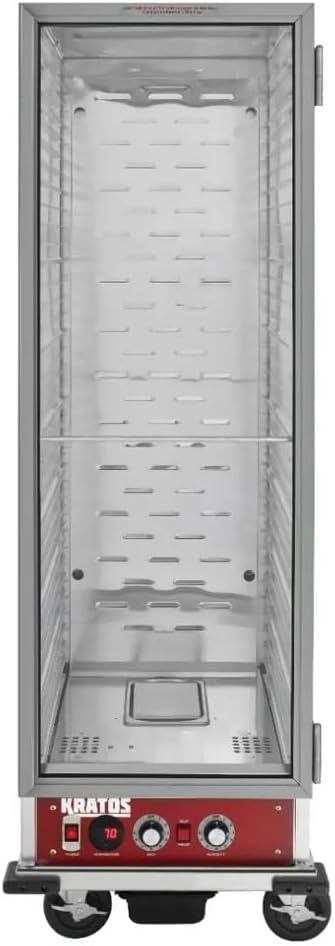
These two cabinet types look nearly identical in a catalog photo — upright insulated boxes with shelves and a control panel — but they serve opposite ends of a prep workflow.
A holding cabinet (also called a hot holding cabinet or food warmer) is designed to keep cooked food at a safe, consistent serving temperature, typically between 140°F and 200°F, for extended periods. The goal is preservation of texture, moisture, and temperature without any additional cooking. Quality units use humid heat — a water pan generates steam that prevents protein from drying out. Budget units use dry heat, which works for some applications (fried items, baked goods) but can ruin a braised brisket in forty minutes.
A proofing cabinet is a humidity-and-warmth environment designed for yeast-leavened doughs. It holds temperatures between roughly 70°F and 115°F — warm enough to activate yeast, humid enough to prevent a crust forming on the dough surface. Some units are combo proofer/holding cabinets, but those typically compromise on the upper-temperature ceiling, which matters if you’re holding anything above 175°F.
For most food truck operators, the path splits early:
- If you’re running baked goods, brioche buns, yeasted flatbreads, or anything where dough is proofed on-site → you need proofing capability
- If you’re running proteins, grains, sauced dishes, or anything batch-cooked at a commissary and transported → you need hot holding
- If you’re running both → you need to understand whether a combo unit’s temperature range actually covers your use case, or whether you’re better off with two purpose-built units and a tighter footprint plan
QSR Magazine’s coverage of holding equipment workflows notes that operators who underinvest in temperature-controlled holding consistently report service bottlenecks during peak windows — not because they’re cooking too slowly, but because the food is ready before the line can absorb it, then drops below safe temperature before it can be served. That’s a compliance problem and a waste problem simultaneously.
The Prep Timeline Math: Why This Matters More Than the Sticker Price
Here’s where operators at the 6-to-24-month mark often miscalculate: they look at a $1,200 half-size holding cabinet and compare it to a $300 residential warming drawer or a $150 hotel pan with a lid. The sticker gap feels decisive. The operational math usually isn’t.
By the numbers — a simplified event-day scenario:
| Scenario | Max safe hold time | Covers served in 90-min window | Food waste (protein batch) |
|---|---|---|---|
| No holding cabinet (hotel pan + lid) | ~25 min before temp drop | 55–65 | ~18% of batch |
| Dry-heat budget warmer | ~45 min | 70–80 | ~12% (texture loss) |
| Commercial humid holding cabinet | 90–180 min | 100–120 | ~4–6% |
These figures are drawn from operator-reported patterns cited in Food Truck Empire’s equipment checklist documentation and corroborated by the temperature-time-control framework in the FDA Food Code 2022. Your specific numbers will vary by protein type, pan depth, and cabinet cycling frequency — but the directional spread is consistent across the literature.
The decision frame here is: what is the revenue value of 40–50 additional covers per event? For a truck averaging $12–$18 per transaction, that’s $480–$900 in a single service window. A $1,200 holding cabinet amortizes in two to three events if the throughput gain holds. Restaurant Business Online’s analysis of holding equipment ROI reinforces this framing — the cost of not holding correctly shows up in waste, reheating labor, and customer experience degradation rather than a visible line item.
Sizing for a Food Truck Footprint: The Numbers That Actually Matter
Full-size holding cabinets — the standard 29” wide, 78” tall roll-in units used in brick-and-mortar kitchens — will not fit in a 14- to 20-foot food truck trailer unless it was purpose-built around them. You’re working with three realistic options:
Half-size (undercounter) holding cabinets: Typically 28”–30” wide, 26”–34” tall, designed to slide under a prep table or sit countertop. Capacity runs 3–5 full-size (18”×26”) sheet pans. These are the workhorse choice for single-trailer operators. Published specs on units from manufacturers like Winholt, Hatco, and Alto-Shaam’s entry line show draw rates between 120V/1,000–1,500W — important because you’re working against generator capacity and shore power limits at event venues.
Undercounter full-width warming drawers (commercial grade): Narrower vertical footprint than a cabinet, often 15”–27” wide. NSF-certified commercial versions hold temperature more consistently than residential models and can be built into a custom trailer fabrication. Not ideal for bulk protein holding but useful as a secondary station.
Combo proofer/holding units: Quarter-size to half-size units, often stackable. The tradeoff, per published manufacturer specs from companies like Doyon and BakeMax, is that the upper-temp ceiling on most combos tops out around 175°F–185°F — workable for most proteins, but check against your specific menu before specifying.
Critical spec to verify before purchasing: Electrical draw and voltage requirement. Many commercial holding cabinets are spec’d for 208V or 240V single-phase — standard in brick-and-mortar but a real constraint on a truck running a 30-amp shore power connection or a 6,500W generator. Small Business Chron’s guidance on mobile kitchen setup consistently flags electrical capacity as the most common mismatch between purchased equipment and field deployment.
If you’re commissioning a custom build, this is a direct conversation to have with your fabricator before the electrical schematic is drawn. If you’re retrofitting an existing trailer, pull the generator spec sheet and calculate remaining capacity before you spec the holding cabinet.
Decision Framework: Which Unit Fits Your Operation
The clearest way to frame this is by menu type, service model, and where your food is actually cooked.
If you prep at a commissary and transport to the event site: You need a holding cabinet that can sustain temperature for transport time plus service window — potentially 3–4 hours total. Look for humid-heat units with a tight temperature variance (±5°F is a meaningful spec; ±15°F is not). Alto-Shaam’s Halo Heat technology and Hatco’s Flav-R-Savor line are cited frequently in operator reviews for consistent humid-hold performance. Published specs on both lines suggest temperature uniformity within ±5°F throughout the cabinet — relevant if you’re stacking multiple pan depths.
If you’re a baked-goods or yeasted-bread operation: Proofing is non-negotiable. The question is whether you’re proofing at the commissary and transporting finished dough, or proofing on the truck. If you’re proofing on the truck, you need a dedicated proofer with reliable humidity control — not a holding cabinet set to low. Look at half-size proofers from Doyon or BakeMax, and confirm the humidity range extends down to 70°F–75°F for slow proofing.
If you’re a high-volume event caterer running 200+ covers: A single half-size cabinet will create a throughput ceiling. Operators at this volume typically run two half-size units or a single three-quarter-size unit, staged so one is cycling food to the line while the other is being reloaded. Food Truck Empire’s interviews with high-volume event operators consistently show this two-cabinet staging model as the inflection point between chaotic service and consistent throughput.
If budget is the binding constraint right now: A used commercial holding cabinet — NSF-certified, 120V, verified thermostat calibration — from a restaurant liquidation source or a Burkett Restaurant Equipment used-equipment listing will outperform a new residential warming drawer at a comparable price point. The NSF certification (National Sanitation Foundation — a mark indicating the unit meets food-safety equipment standards) matters both for commissary compliance and for health inspector interactions at events.
What to Ask Before You Buy
Whether you’re sourcing through WebstaurantStore, Burkett, or a direct fabricator spec, these are the questions that prevent a mismatch:
- What is the operating voltage and amperage draw? Match this against your truck’s available electrical capacity before purchase.
- Is it humid-hold or dry-hold? If you’re holding proteins or anything sauced, humid-hold is the correct answer.
- What is the temperature variance across shelves? Ask for the spec sheet, not the sales pitch.
- Is it NSF-certified? If you’re operating under commissary agreements or in states with strict mobile food unit inspections, this is typically required — not optional.
- What are the external dimensions, and have you measured your truck’s installation space including door swing and ventilation clearance? Fabricators at the custom-build tier (Prestige Food Trucks, Cruising Kitchens, Custom Concessions International) will tell you that equipment-to-space mismatches are among the most common rework issues on mid-build changes.
Marco’s second Saturday at that farmers market — the first one with the holding cabinet fully staged — he ran out of food before he ran out of customers. That’s a different kind of problem, and a much better one to have.