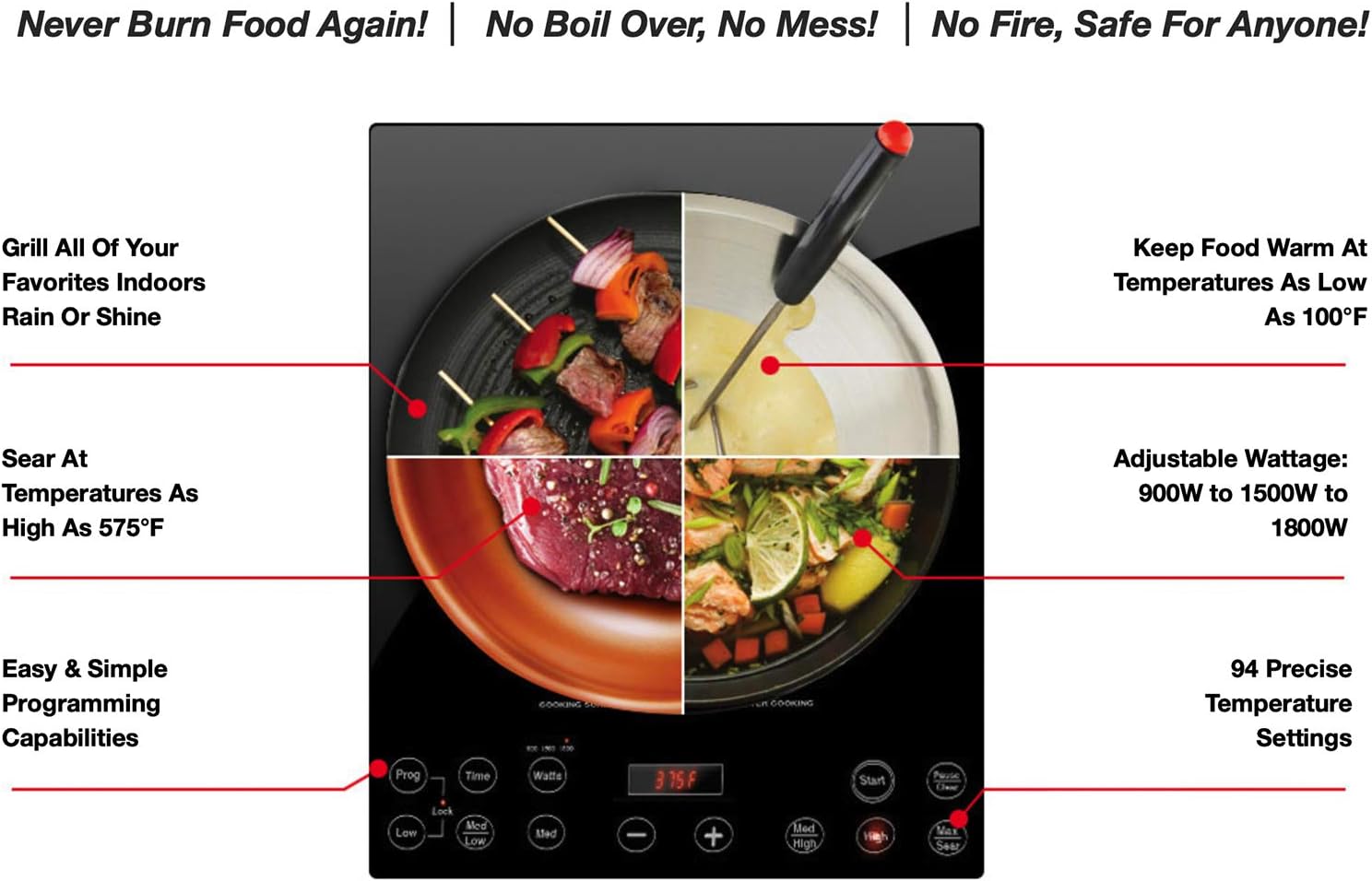
Maria had been running her tamale truck for two years when the county health inspector walked in during a Friday lunch rush, looked at the single-burner induction cooktop sitting on her prep table, and asked one question: “Is that NSF-certified?” She pointed to a sticker on the bottom. The inspector photographed it, shook his head, and wrote up a corrective action. The sticker said “NSF 61” — a certification for drinking water components, not food preparation surfaces. Her cooktop was, technically, NSF-certified. Just for entirely the wrong thing.
If you’re equipping a food truck or mobile kitchen, “NSF-certified” sounds like a single, simple box to check. It isn’t. NSF International (a nonprofit that sets public health standards) runs dozens of distinct certification programs, each covering a different category of equipment or materials. Health inspectors who know their codes will ask not just whether something is certified, but which standard it’s certified to. This guide breaks down exactly which certifications pass inspection for induction cooktops in a mobile food-service context, where the gray areas live, and how to verify what you’re actually buying before you sign a build sheet or click purchase.
| EDITOR'S PICK[ChangBERT Portable Induction Co…](https://www.amazon.com/dp/B0B4J6PXPN?tag=greenflower20-20) | Mid-tier[Nuwave Portable Induction Cookt…](https://www.amazon.com/dp/B0DM6VPPQS?tag=greenflower20-20) | Budget pick[Nuwave Pro Chef Induction Cookt…](https://www.amazon.com/dp/B085J2PQRB?tag=greenflower20-20) | |
|---|---|---|---|
| Power | 3200W | — | 1800W |
| Voltage | 208-240V | — | — |
| Temp settings | — | 94 | 94 |
| Coil size | — | 8" | 8" |
| Temp range | — | — | 100°F-575°F |
| Shatter-proof | — | ✓ | ✓ |
| Price | $299.99 | $153.99 | $139.99 |
| See on Amazon → | See on Amazon → | See on Amazon → |
Why “NSF-Certified” Alone Means Almost Nothing
Here’s the uncomfortable truth: the phrase “NSF-certified” on a product listing is marketing language until you dig one layer deeper. NSF International publishes more than 80 standards. A unit can legitimately claim certification while being completely irrelevant to your inspection scenario.
For commercial cooking equipment — which is what an induction cooktop in a food truck is — the standard you need is NSF/ANSI 4. This is the standard governing commercial cooking, rethermalization (reheating), and powered hot-food holding equipment. It covers surface materials, cleanability, clearances, and construction requirements that health departments actually audit. Per NSF International’s published standard documentation for NSF/ANSI 4, equipment must meet criteria around smooth, non-porous, corrosion-resistant surfaces; no exposed threads or seams that trap food particles; and design that permits effective cleaning without disassembly.
The other certifications you’ll commonly see — and should not confuse with NSF/ANSI 4 — include:
- NSF 61: Drinking water system components. Irrelevant to food prep surfaces.
- NSF 51: Food zone materials only — plastics and elastomers that contact food. Occasionally seen on cooktop knob or housing materials. Not a whole-unit certification.
- NSF 2: Refrigerators and food storage equipment. Not cooking equipment.
- ETL Listed or UL Listed: Electrical safety certifications. Required and important, but separate from sanitation compliance. An ETL listing tells the inspector the unit won’t start a fire; it says nothing about cleanability.
Restaurant Business Online’s coverage of equipment certification notes that inspectors in jurisdictions following the FDA Food Code — which, as of 2022, has been adopted in some form by 49 states — are directed by Section 4-205.10 to require that commercial cooking equipment be certified by an American National Standards Institute (ANSI) accredited body to an appropriate NSF standard. That’s the regulatory hook. The FDA Food Code 2022, Section 4-205.10, specifically states that food equipment must meet standards “for materials, design, construction, and workmanship” as certified by an accredited certification organization.
In practice, this means NSF/ANSI 4 certification — or in some jurisdictions, equivalent certification from bodies like UL (Underwriters Laboratories) to the same standard — is what inspectors are actually looking for when they ask about your cooktop.
The Portable vs. Countertop Distinction That Trips People Up
This is where practitioners often get burned: there’s a functional difference between a portable induction unit (think sub-20-pound, consumer or prosumer grade, single zone) and a countertop commercial induction cooktop (heavier-gauge housing, higher sustained wattage, built for continuous-use environments).
Most portable induction units sold on general retail platforms — even those marketed as “commercial” or “restaurant-grade” — are not NSF/ANSI 4 certified. They may carry ETL or UL electrical certifications. They may even perform reliably for years. But when an inspector specifically asks for NSF/ANSI 4 documentation and your unit only has an ETL listing, you’re in corrective-action territory.
Food Truck Empire’s health inspection guidance notes that inspectors in urban markets and at larger events (festivals, stadiums, corporate campuses) have become significantly more rigorous about equipment certification documentation over the past three years. The days of pointing to a sticker and moving on are ending, particularly in California, New York, Illinois, and Texas — states that have adopted the 2022 FDA Food Code with minimal modification.
The practical breakpoint by budget:
| Unit Type | Typical Price Range | NSF/ANSI 4 Certified? | Best For |
|---|---|---|---|
| Consumer portable induction | $40–$150 | Rarely | Low-volume, non-inspected contexts |
| Prosumer single-zone | $150–$400 | Sometimes — verify | Catering supplement, back-of-truck prep |
| Commercial countertop induction | $400–$1,200 | Usually — verify per SKU | Primary cook station, health dept. markets |
| Built-in commercial induction (custom build) | $1,200–$4,000+ | Required for NSF/ANSI 4 | Full truck builds, fleet deployments |
The “verify per SKU” note in that table is not a hedge — it’s a hard requirement. Certification is issued to specific models, not product lines. A manufacturer’s flagship induction line may carry NSF/ANSI 4 while a lower-tier model from the same brand does not. QSR Magazine’s coverage of induction adoption in commercial kitchens specifically flags this model-level verification gap as a common source of compliance problems for operators who assume brand-level certification carries across a product family.
How to Verify Certification Before You Buy
Here’s the decision process that should be standard before any cooktop goes on a build sheet:
Step 1: Find the NSF listing, not just the claim. NSF International maintains a public database — the NSF Product and Service Listings — searchable by company name, product category, or standard number. Search for the specific model number under Standard 4. If it’s not listed there, the certification claim on the product page is either outdated, incorrect, or refers to a different standard. This database is free and publicly accessible at nsf.org.
Step 2: Pull the certification document, not just the sticker. Reputable distributors — Burkett Restaurant Equipment, WebstaurantStore, and similar — will include certification documentation in product detail pages for genuinely certified units. If you’re buying from a fabricator doing a full build, ask for the equipment specifications sheet that lists the NSF standard number for each piece of cooking equipment. This becomes part of your inspection documentation package.
Step 3: Match the certification to your jurisdiction’s adopted code. Most states follow the FDA Food Code, but some maintain their own modified versions with different equipment approval pathways. California’s Retail Food Code (CalCode), for example, has specific requirements that can diverge from the base FDA Food Code. If you’re operating in a state with a modified code, contact your local environmental health department before finalizing equipment selections. A fifteen-minute call can save a four-figure equipment replacement.
Step 4: Ask your commissary kitchen. If you’re required to operate out of a licensed commissary (which most jurisdictions require for food trucks), the commissary operator has almost certainly dealt with your local health department’s equipment requirements many times. They often know exactly which models local inspectors accept without issue. That’s free institutional knowledge — use it.
The UL vs. NSF Overlap (and When Each Matters)
One more wrinkle worth naming explicitly: some commercial induction cooktops are listed under UL 197 — UL’s standard for commercial electric cooking equipment — rather than NSF/ANSI 4. UL 197 covers electrical safety and some construction requirements, and in certain jurisdictions, UL 197 listing is accepted as equivalent to NSF/ANSI 4 for inspection purposes.
However, this equivalency is jurisdiction-dependent. In markets following the FDA Food Code strictly, NSF/ANSI 4 (or certification by another ANSI-accredited body to the same standard) is the baseline. In other markets, a UL 197 listing combined with materials documentation may satisfy an inspector. The FDA Food Code 2022 language in Section 4-205.10 specifies certification by “an American National Standards Institute (ANSI)-accredited certification organization” — UL is ANSI-accredited, which is why UL 197 sometimes satisfies this requirement.
The safest path for a mobile operator: look for units that carry both NSF/ANSI 4 certification and UL or ETL electrical listing. These aren’t redundant — they cover different compliance dimensions. NSF/ANSI 4 addresses sanitation construction. UL/ETL addresses electrical safety. Both matter; neither substitutes for the other.
The Decision Rule
If you’re making a cooktop decision right now — whether for a first build, a replacement unit, or a fleet spec — here’s the clear if/then framework:
If you’re operating in an inspected market (any licensed food truck context in a jurisdiction that has adopted the FDA Food Code in any form): Only purchase countertop or built-in induction units with confirmed NSF/ANSI 4 certification, verified against the NSF product listing database by specific model number. Budget $400 minimum for a single commercial-grade unit; $800–$1,200 is the realistic range for units operators in long-run reviews consistently describe as reliable under sustained daily use. Do not assume brand-level certification. Verify the SKU.
If you’re building a full turnkey truck with a fabricator like Prestige Food Trucks, Cruising Kitchens, or Custom Concessions International: Require your build contract to specify the NSF standard number for every cooking equipment line item. A contract that says “commercial induction cooktop” without specifying the certification standard is leaving a compliance gap that becomes your problem at inspection, not the fabricator’s.
If you’re equipping a low-volume catering supplement setup that won’t face permit inspection: A prosumer unit with ETL electrical certification may be operationally sufficient — but be clear-eyed that this is a compliance risk if your operating context ever changes or expands.
If you’re uncertain about your local jurisdiction’s specific requirements: Call your county or city environmental health department, bring your proposed equipment’s model number, and ask directly. Inspectors would genuinely rather answer that question before your build than write a corrective action during your first health inspection. Every experienced operator who’s been through this process once will tell you the same thing: the call costs nothing; the correction costs time, money, and sometimes a temporarily shuttered truck.
Maria replaced her cooktop the following week. The new unit cost $680 and carried both NSF/ANSI 4 certification and an ETL electrical listing. Her next inspection was clean. The sticker on the bottom said the right thing, and — more importantly — she could prove it.