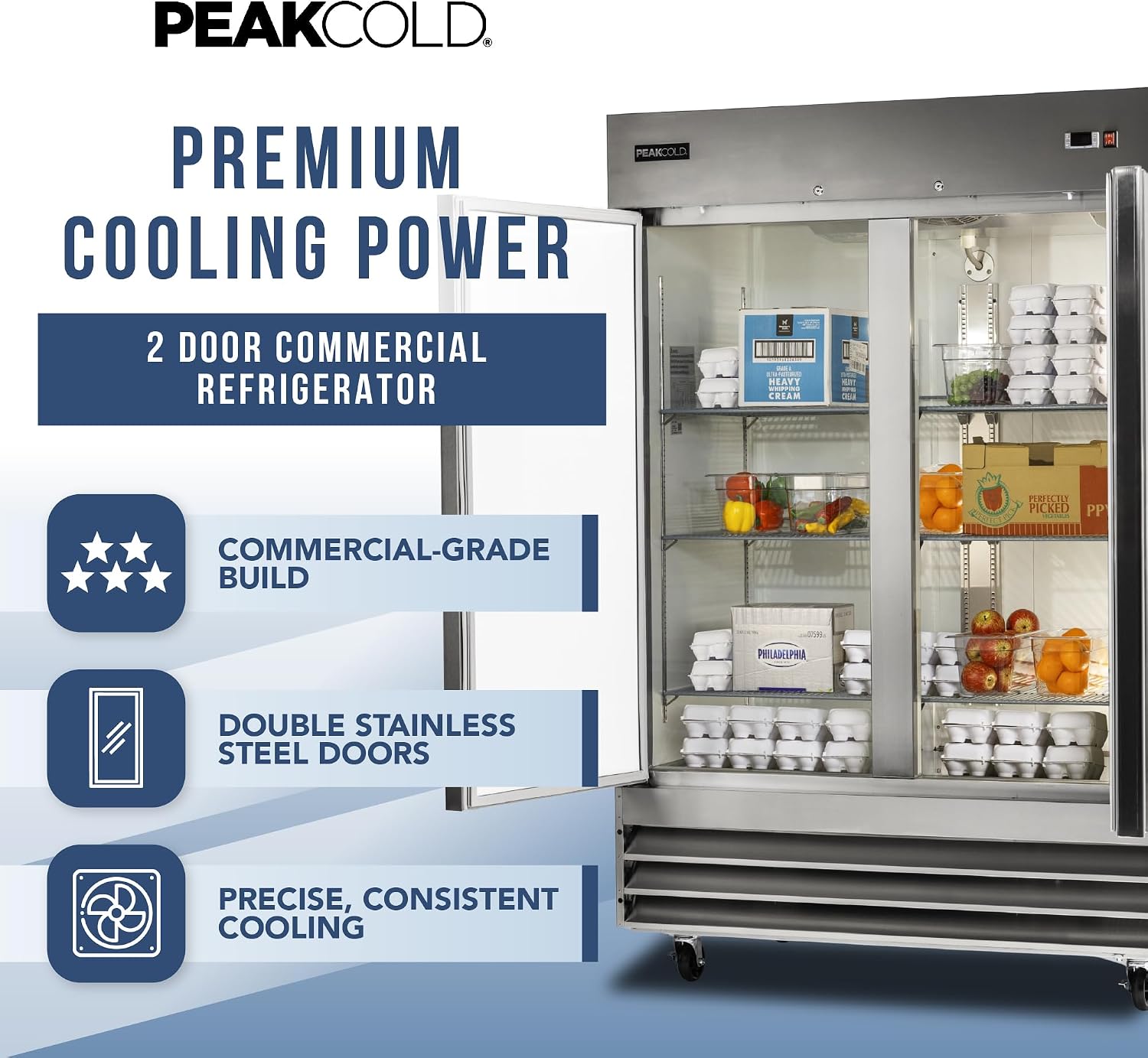
Marcus runs a Gulf Coast seafood trailer. Last July, he called his fabricator midway through his second summer season to report that his reach-in refrigerator — a perfectly respectable unit he’d pulled from a restaurant liquidation sale — was running constantly and still couldn’t hold 38°F when afternoon temps climbed past 95°F. The compressor (the refrigerator’s engine, the mechanical pump that circulates refrigerant and actually creates the cold) was mounted on top of the unit. In a fixed restaurant, that’s fine. In a trailer with a low ceiling and no cross-ventilation, the compressor was essentially breathing its own exhaust and working itself to failure. Marcus’s problem wasn’t the brand, the age, or the price of the unit. It was compressor location — and nobody had told him that mattered.
If you’re equipping a mobile kitchen and shopping reach-in refrigerators (the upright, full-height or half-height cabinets with solid or glass doors that you reach into for ingredients during service), this article is the decision framework you need before you buy. We’ll cover the three variables that actually separate a good mobile refrigeration choice from an expensive mistake: how much cubic footage you realistically need, where the compressor sits on the unit, and what the ambient temperature problem means for your climate and your build. You’ll leave with a clear if/then decision rule.
| EDITOR'S PICKCommercial Refrigerator and Fre… | Mid-tier[PEAKCOLD Double Door Commercial…](https://www.amazon.com/dp/B088MFYBW4?tag=greenflower20-20) | Budget pick[KoolMore 23 in. One Glass Door…](https://www.amazon.com/dp/B0CY41Y5KY?tag=greenflower20-20) | |
|---|---|---|---|
| Capacity | 39 Cu.ft | 47 Cu. Ft. | 10 cu. ft. |
| Width | 48" | 54" | 23 in. |
| Type | Dual Temp Combo | Reach-In | Display Merchandiser |
| Doors | 2 | 2 | 1 |
| Shelves | 8 Adjustable | Adjustable | — |
| Defrost Type | — | Auto Defrost | — |
| Price | $2,310.00 | $2,195.00 | $907.51 |
| See on Amazon → | See on Amazon → | See on Amazon → |
Why Mobile Refrigeration Is a Different Animal Than Restaurant-Grade “Restaurant Refrigerators”
The restaurant equipment market is enormous, and most of the reach-in refrigerators you’ll find on the used market or through suppliers like WebstaurantStore or Burkett Restaurant Equipment were designed for brick-and-mortar kitchens. That matters because the NSF/ANSI Standard 7 rating — the certification (from NSF International, the public health standards body) that tells you a refrigerator meets commercial food safety specifications — is tested at a controlled ambient temperature of 75°F. Per NSF International’s NSF/ANSI Standard 7 documentation, this is the standard test condition for commercial refrigerators and freezers.
Your trailer in Phoenix in August is not 75°F. Your truck parked in a festival lot in New Orleans in June is not 75°F. The interior of a metal-clad trailer with a six-burner range firing on a 92°F day can push ambient temperatures at the compressor level past 110°F. At that point, a unit rated for 75°F ambient performance is operating outside its design envelope — it will either struggle to hold safe temperatures (below 41°F, per the FDA Food Code 2022 requirement for temperature control for safety foods) or it will overheat and fail.
The good news: the variables are manageable if you understand them before you buy.
Cubic Footage: The Number Operators Almost Always Miscalculate
The instinct is to buy big. The practical reality on a 14- to 20-foot trailer or a Class 6 truck is that cubic footage costs you in three currencies simultaneously: floor space, electrical draw, and BTU load (the amount of heat the compressor dumps into the already-hot kitchen).
The baseline math for mobile operators:
| Operation Type | Recommended Starting Capacity | Notes |
|---|---|---|
| Single-concept, 1–2 proteins | 20–27 cu ft reach-in | Half-height or 1-door full-height |
| Multi-protein menu, 100–200 covers/day | 27–49 cu ft | 2-door full-height; may need supplemental undercounter |
| Event catering, prep-heavy | 49+ cu ft or dual units | Consider split: one reach-in, one undercounter |
Food Truck Empire’s overview of mobile refrigeration sizing notes that operators consistently underestimate their vegetable and sauce volume while overestimating their protein volume — produce takes up more space per pound than most people plan for.
The practical rule: calculate your peak-day par (the maximum amount of product you’d carry for your busiest day), then add 20% buffer for safe air circulation inside the cabinet. A packed refrigerator with no airflow around product is functionally performing worse than its rated capacity.
Don’t forget electrical draw. A standard 2-door reach-in commercial refrigerator draws 7–12 amps at 115V during the compressor run cycle. On a trailer running a 30A or 50A service, every amp is budgeted. Restaurant Business Online’s coverage of small-footprint cold storage decisions notes that electrical load planning is consistently the most deferred — and most painful — line item in mobile builds.
Compressor Location: Top-Mount vs. Bottom-Mount, and Why It Changes Everything in a Trailer
This is the variable Marcus got wrong, and it’s the one most often glossed over in equipment listings.
Top-mount compressors sit on top of the cabinet. In a restaurant kitchen, this works well: the compressor exhausts heat upward, away from stored food, and the kitchen has enough ceiling height and ventilation to dissipate it. On a trailer, you’ve got 18–24 inches of clearance above a tall reach-in, and that hot exhaust air has nowhere to go. The compressor ends up working against an ambient temperature of its own making.
Bottom-mount compressors sit in a kick-plate compartment below the cabinet. They exhaust heat downward and toward the front — in a mobile environment, that’s toward a floor-level area that’s easier to ventilate (or at minimum, easier to keep from trapping hot air near the compressor itself). Operators in long-run reviews of mobile-spec refrigeration units consistently flag bottom-mount as the better choice for trucks and trailers, precisely because of the exhaust heat dynamic.
The tradeoff: Bottom-mount units are slightly harder to service. The compressor compartment is low, access requires crouching or removing the unit from its slot, and debris tends to accumulate in bottom-mount kick plates faster than top-mount housings. If you’re in a dusty or high-particulate environment (festivals, outdoor events, unpaved lots), you need to commit to quarterly cleaning of the condenser coils — the fins that actually release heat from the refrigerant — or bottom-mount performance advantages erode quickly.
Remote condensers are a third option available on higher-end builds. A remote condenser setup (found on some True, Hoshizaki, and Beverage-Air commercial lines) separates the heat-generating condenser unit entirely — mounting it outside the trailer on the roof or exterior wall — while the refrigerated cabinet stays inside. This is the cleanest solution for ambient temperature management, but it adds $800–$2,500 in installation cost depending on line-set length and the fabricator’s HVAC routing. For builds in the $80,000–$150,000 range, QSR Magazine’s coverage of equipment durability in non-traditional environments suggests remote condenser setups have a measurable impact on compressor longevity in high-ambient deployments.
The Ambient Temperature Problem: Ratings, Real-World Limits, and What to Specify
Here’s the core decision frame: every reach-in refrigerator has an ambient temperature rating — the maximum surrounding air temperature at which it can hold food at or below 41°F. This rating is almost never printed prominently on the sales listing. You have to find it in the spec sheet.
Standard NSF/ANSI 7-certified units are tested at 75°F ambient, as noted above. Some manufacturers produce high-ambient variants — units tested and rated for 80°F, 90°F, or even 100°F ambient operation. These use higher-capacity compressors, larger condenser coils, and sometimes variable-speed fan motors to manage the additional heat load. They cost 15–30% more than standard-ambient equivalents at comparable cubic footage.
The if/then rule for ambient temperature:
- If your operation is primarily in climates with summer highs below 85°F (Pacific Northwest, upper Midwest, New England shoulder seasons): a standard NSF 7-rated unit with a bottom-mount compressor and good condenser maintenance is likely sufficient.
- If your operation runs in climates with regular summer highs above 90°F (Gulf Coast, Southwest, Southeast, high-altitude desert): specify a high-ambient unit, prioritize bottom-mount or remote condenser, and build condenser cleaning into your monthly PM (preventive maintenance) schedule.
- If your trailer has poor ventilation or an enclosed kitchen bay: treat your ambient condition as one tier hotter than the outside temperature suggests, regardless of geography.
The FDA Food Code 2022 is unambiguous that temperature control for safety foods must be maintained at 41°F or below during cold holding. A refrigerator that struggles to maintain that threshold doesn’t just risk spoilage — it’s a health code violation that can pull your permit.
NSF Certification, Commissary Compliance, and the Inspection Angle
If you’re operating out of a licensed commissary — a shared commercial kitchen that provides your legal base of operations, required in most states for mobile food permits — your refrigeration equipment may need to meet that commissary’s inspection standards, not just mobile health department standards. NSF International’s NSF/ANSI Standard 7 certification is the baseline specification most health departments and commissary operators recognize.
Before buying, confirm:
- The unit carries current NSF/ANSI 7 certification (not just “commercial grade,” which is a marketing term, not a certification)
- Your state or county health department accepts that certification for mobile permit renewal
- If you’re buying used, the NSF certification plate on the unit is intact and legible (inspectors check the physical tag)
Food Truck Empire’s guidance on commissary compliance notes that used refrigeration equipment is one of the most common points of friction in mobile permit inspections, specifically because NSF tags are removed or damaged during transportation from restaurant liquidation sites.
A Note on Used vs. New for Mobile Applications
The used market makes economic sense for many operators, but reach-in refrigerators for mobile applications carry specific risk factors that don’t apply to, say, a used prep table. Compressors accumulate run-hours, and a unit that spent five years in a climate-controlled restaurant kitchen will behave differently in a 95°F trailer environment even if its run-hours look reasonable. If you’re buying used, pull the compressor model number and look up its ambient rating independently — don’t rely on the overall unit’s original spec, because replacement compressors don’t always match the original’s ambient performance tier.
New units from full-line commercial suppliers like True Refrigeration, Hoshizaki, Beverage-Air, or Turbo Air offer published spec sheets with ambient ratings, warranty coverage that typically runs 1–5 years on the compressor, and the ability to specify the exact configuration (bottom-mount, high-ambient, remote-condenser-ready) before purchase. For builds at the $80,000+ tier where the refrigerator is one line item in a six-figure build, the price delta between a $1,800 standard unit and a $2,400 high-ambient bottom-mount unit is noise — and the operational difference in a hot climate is not.
The decision rule, plainly stated: If you’re operating above 85°F ambient for more than 30 days per year, bottom-mount or remote condenser is not optional — it’s insurance. Size to your actual peak-day par plus 20%, verify the NSF/ANSI 7 certification tag is intact, and pull the spec sheet ambient rating before the purchase order is signed. Marcus eventually replaced his top-mount unit with a bottom-mount high-ambient Beverage-Air model and added a small exhaust fan at ceiling level near the compressor bay. His second summer ran without a single temperature flag. The fix cost him about $2,600 total. The original mistake cost him a compressor, a health inspection citation, and a full day of lost revenue in the middle of peak season.
Get this decision right once. It holds for the life of the build.