Maria had her build spec locked — a 20-foot trailer with a six-burner range, a two-compartment sink, and what her fabricator called a “standard sandwich unit.” She didn’t ask what that meant. Three weeks after opening, a health inspector flagged her prep table during a busy Saturday lunch: the rail temperature — that’s the open refrigerated trough along the top where you keep ready-to-use ingredients — was reading 42°F instead of the legally required 41°F or below. One degree. She passed reinspection the next morning, but she lost a permit sticker and spent two panicked hours on the phone with her equipment supplier. The unit wasn’t broken. It was undersized for her ambient kitchen temperature. She’d bought a prep table spec’d for a climate-controlled restaurant, not a trailer baking in July sun.
If you’re in the middle of a food-truck build or negotiating a commissary compliance package right now, this guide will help you avoid Maria’s situation. We’ll break down what NSF certification actually requires of a prep table, how to match pan count to your menu, and what the cold-hold compliance math looks like at your actual operating temperatures — not in a showroom.
| EDITOR'S PICK60" W 2 Door Refrigerator Sandw… | Mid-tier[VEVOR Commercial Refrigerator](https://www.amazon.com/dp/B0FDQ9K7PR?tag=greenflower20-20) | Budget pick[VEVOR Commercial Refrigerator](https://www.amazon.com/dp/B0DNMN8L4X?tag=greenflower20-20) | |
|---|---|---|---|
| Width | 60" | 48" | 28" |
| Pan Count | 16 | — | 8 |
| Capacity | 16.4 cu.ft | 12.85 cu.ft | 7.1 cu.ft |
| Cutting Board | ✓ | — | — |
| Lock | — | ✓ | — |
| Price | $1,729.00 | $1,273.90 | $1,099.90 |
| See on Amazon → | See on Amazon → | See on Amazon → |
What NSF Certification Means (and What It Doesn’t Guarantee)
NSF-certified equipment — meaning units that have been evaluated and listed under NSF/ANSI Standard 7: Commercial Refrigerators and Freezers, published by NSF International — is the baseline your health department will check for. The NSF mark tells an inspector that the unit’s materials are food-safe, its surfaces can be cleaned without harboring bacteria, and its refrigeration system was tested to maintain temperature under defined conditions.
Here’s what most operators miss: NSF/ANSI Standard 7 test conditions are standardized at 75°F ambient air temperature. Your food-truck kitchen on an August afternoon in Phoenix, Houston, or Miami is not 75°F. It can be 95°F–110°F inside the trailer. That gap is where compliance failures happen.
NSF certification is a necessary condition for health-department approval — it is not a performance guarantee for your specific environment. Per the FDA Food Code 2022, Section 3-501.16, all potentially hazardous foods (PHF) — think sliced deli meats, shredded cheese, cut tomatoes, any protein — must be held at 41°F or below during cold storage and active prep. That standard doesn’t flex because your kitchen runs hot. The equipment has to compensate.
When you’re evaluating spec sheets, look for two numbers beyond the NSF listing: ambient operating range (some units are rated to 90°F ambient, others only to 75°F) and compressor BTU or horsepower rating. A prep table with a 1/5 HP compressor is engineered for a different load than one with a 1/3 HP or 1/2 HP unit. QSR Magazine’s refrigeration buying coverage notes that undersized compressors are the leading cause of mobile-kitchen cold-hold failures — not mechanical defects, just thermal mismatch.
Pan Count: Matching the Rail to Your Menu
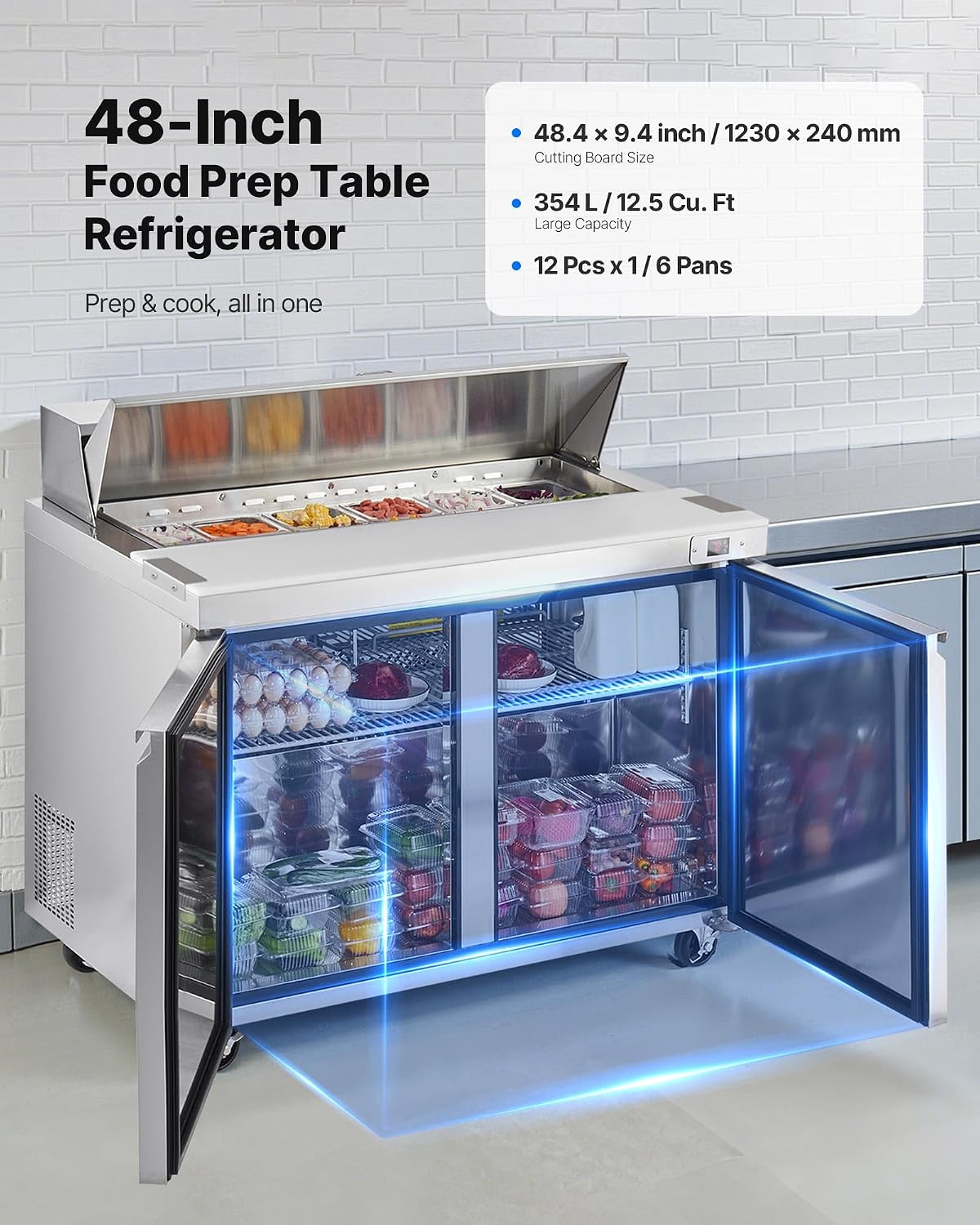
A refrigerated prep table’s capacity is expressed in pan count — specifically, the number of standard 1/3-size or 1/6-size hotel pans (shallow metal or polycarbonate containers) that fit in the open top rail. A 27-inch unit typically holds 4–6 pans. A 48-inch unit holds 9–12. A 60-inch unit can reach 16–18.
The instinct to buy more rail space than you think you need is sound — but in a food-truck build, counter inches are currency. Every inch you allocate to a prep table is an inch you’re not giving to a steam table, a fryer landing zone, or a ticket printer. This is the core tradeoff.
The right pan count starts with your menu’s ingredient matrix. Walk through your highest-volume menu item and count distinct cold-hold ingredients. A build-your-own taco truck might run: proteins (2–3 options), shredded cheese, pico, sour cream, guacamole, jalapeños, shredded lettuce, and two sauces. That’s 9–11 pans minimum for a single-item menu concept. A smash-burger operation might need: raw beef portions, shredded lettuce, sliced tomatoes, sliced onions, pickles, two house sauces, and American cheese slices — call it 7–9 pans. Now ask: do you run two menu categories at once? A brunch-to-lunch crossover truck might need 14–16 pans to cover both service windows without mid-shift restocking.
By the Numbers — Typical Mobile Prep Table Specs:
| Unit Width | Typical Pan Capacity | Compressor Range | Approx. Price Range (2026) |
|---|---|---|---|
| 27 in. | 4–6 × 1/3 pans | 1/5 HP | $900–$1,400 |
| 48 in. | 9–12 × 1/3 pans | 1/4–1/3 HP | $1,500–$2,400 |
| 60 in. | 14–16 × 1/3 pans | 1/3–1/2 HP | $2,200–$3,500 |
| 72 in. | 18–22 × 1/3 pans | 1/2 HP | $3,000–$4,800 |
Price ranges reflect typical commercial equipment market pricing as of mid-2026 at distributor tiers. Custom mobile-grade or enhanced-compressor models carry premium above these figures.
Food Truck Empire’s health inspection prep coverage consistently flags pan count undersizing as a menu-execution problem, not just a compliance one: when operators run out of rail space mid-service, pans come out of the rail and sit on the counter. That’s a temperature violation and a cross-contamination risk in one move.
Cold-Hold Compliance in a Hot Trailer: The Real Math
Let’s put numbers on the ambient temperature problem. A refrigerated prep table’s compressor has to work harder as the surrounding air gets hotter — it’s fighting a larger temperature differential to keep that rail at 41°F. The relationship is roughly linear: for every 10°F increase in ambient air above the unit’s rated test temperature, you can expect meaningful degradation in rail holding temperature if the compressor is at or near its rated capacity.
Restaurant Business Online’s refrigeration guide for small operators recommends a practical rule of thumb: spec the unit as if your kitchen will run 15°F hotter than your worst-case ambient outdoor temperature. If your market is Miami and you’re running summer events, outdoor ambient might peak at 98°F. Your trailer interior with range and fryer running could hit 110°F. Your prep table needs to be rated — or derated-tested by the manufacturer — for 110°F ambient, or you’re flying close to the sun.
Some operators solve this with supplemental cooling: a roof-mounted HVAC or a dedicated split-system for the prep area. This is common in premium builds at the $80,000–$150,000 tier and above. If your build budget doesn’t include trailer HVAC, you need to compensate with more compressor capacity in the prep table itself.
Three practical specs to verify before you sign a purchase order:
-
Ambient temperature rating on the spec sheet. If it only says “NSF listed” without an ambient operating range, call the manufacturer and ask. If they can’t answer, move on.
-
Refrigeration system type. Forced-air systems (a fan circulates cold air through the pan rail) are more consistent at holding temp under load than static or gravity-draft systems. For mobile use in variable ambient, forced-air is the standard you want.
-
Digital thermostat with external display. You should be able to read the actual rail temperature without opening a panel. This isn’t a luxury — during a health inspection, an inspector will want to see that reading. Units without an external display force you to use a probe thermometer for every verification, which creates a documentation burden and slows you down during service.
NSF-Certified vs. Commercial-Grade vs. “Restaurant-Style”: Know What You’re Buying
This distinction matters more in the food-truck market than almost anywhere else, because the buying channels are noisier. On restaurant equipment sites — including Burkett Restaurant Equipment and WebstaurantStore, both well-regarded in the mobile-kitchen community — you’ll find genuine NSF-listed commercial prep tables alongside units described as “commercial-grade” or “restaurant-style” that carry no NSF listing.
“Commercial-grade” is a marketing descriptor, not a certification. It has no regulatory meaning. A health inspector will not accept it in place of an NSF mark on a mobile food facility permit application. If your local health department follows the FDA Food Code (most do, with state-level amendments), NSF/ANSI 7 listing is the baseline. Some jurisdictions accept UL EPH (Underwriters Laboratories’ Environmental and Public Health standard) as equivalent — call your county environmental health office before you buy if you’re in any doubt.
The price gap between a genuine NSF-listed prep table and a commercial-grade lookalike can be $300–$600 for comparable sizes. That delta feels meaningful on a tight startup budget. It is not worth it. A permit hold or a re-inspection fee will cost you more than that in a single lost service day, and some jurisdictions require removal and replacement of non-compliant equipment before they’ll issue a temporary operating certificate.
The Decision Framework: If X, Then Y
If you’re finalizing a build spec right now, here’s how to cut through the options:
If your menu runs 8 or fewer cold-hold ingredients and your trailer will have HVAC: A 48-inch, 1/3 HP forced-air prep table with NSF/ANSI 7 certification and a 90°F ambient rating is your floor. Operators in aggregated long-run reviews consistently report this is the sweet spot for single-concept trucks in moderate climates.
If your menu runs 9–14 cold-hold ingredients or you’re operating in a hot-summer market without trailer HVAC: Move to a 60-inch unit with a 1/2 HP compressor and confirm an ambient operating rating of at least 100°F. Budget $2,200–$3,200 at distributor pricing. This is the unit that saves you on a 98°F July Saturday.
If you’re running a multi-concept menu, a full catering rig, or a high-volume event truck with 15+ cold-hold SKUs: A 72-inch unit is the right call, and you should be having a conversation with your fabricator about dedicated refrigeration zone cooling in the trailer build — not just a bigger compressor. At the $80,000–$250,000 custom-build tier, supplemental HVAC is a standard line item; make sure your fabricator includes it.
If you’re at the startup tier and the NSF-listed unit strains your budget: Buy the NSF unit and buy a smaller one. A 27-inch prep table with proper certification will pass inspection. A 48-inch “commercial-grade” unit will not. Compliance isn’t optional; pan count is.
One more thing Maria learned after her temperature incident: she now logs her rail temp every two hours on a paper chart clipped to the inside of her trailer door. It takes 30 seconds. If an inspector walks up during service, she hands them documented proof that the unit has been in compliance all day. It’s not required in every jurisdiction, but Food Truck Empire’s inspection guidance notes that proactive temperature logs consistently soften inspector interactions and provide a paper trail if a unit starts drifting before you notice. Buy the right table. Then document it like your permit depends on it — because eventually, it will.