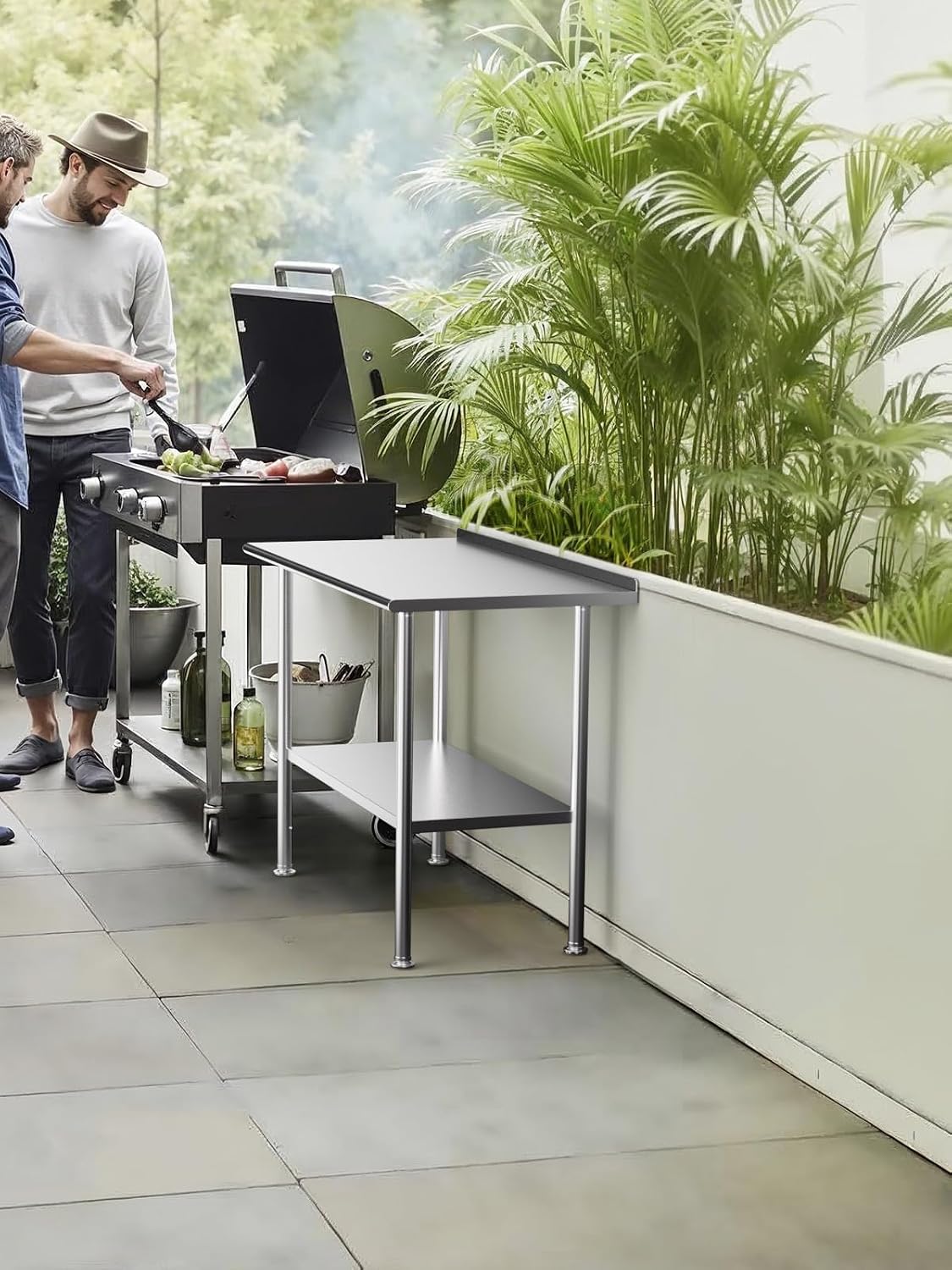
Marcus had his 16-foot trailer floor plan taped out on his garage floor — gridlines in blue painter’s tape, every appliance footprint labeled with a Post-it. He’d spec’d a 48-inch prep table based on what he’d seen in a YouTube build tour. Then his fabricator called to say the hood system, the under-counter refrigerator, and the required aisle clearance left him with exactly 43 inches of usable wall space. Five inches. Gone. And Marcus wasn’t buying a custom-cut table on a $6,000 equipment budget.
This scenario plays out in dozens of food truck builds every month. A stainless steel prep table — essentially a heavy-gauge metal worksurface, usually with an undershelf and sometimes with drawers or refrigerated bases — sounds like a simple purchase. It isn’t. When you’re working inside a 60-to-120-square-foot kitchen that also needs to pass health inspection and survive 200-mile hauls, the decision involves certification requirements, gauge tradeoffs, and a dimensional precision most operators don’t think about until they’re standing in a half-finished truck with a tape measure and a sinking feeling.
This guide will walk you through what NSF certification actually requires (and what happens if you skip it), how to read a spec sheet for a mobile environment, and a clear decision framework for choosing table size, gauge, and configuration based on your actual build constraints.
| EDITOR'S PICK[HARDURA Stainless Steel Table 3…](https://www.amazon.com/dp/B0BZBSYRWV?tag=greenflower20-20) | Mid-tier[Hally Stainless Steel Table for…](https://www.amazon.com/dp/B0863R7WFZ?tag=greenflower20-20) | Budget pick[GRIDMANN Stainless Steel Kitche…](https://www.amazon.com/dp/B015T6OVAO?tag=greenflower20-20) | |
|---|---|---|---|
| Dimensions | 30 x 60 in | 24 x 60 in | 30 x 24 in |
| Backsplash | 2" | — | Yes |
| Undershelf | Adjustable | Yes | Yes |
| Wheels/Casters | Yes | — | — |
| Leg Material | — | Galvanized | — |
| Price | $279.99 | $194.39 | $129.99 |
| See on Amazon → | See on Amazon → | See on Amazon → |
What NSF Certification Means — and Why Your Health Inspector Will Ask
NSF International’s NSF/ANSI 2: Food Equipment standard is the benchmark most state and local health departments use when evaluating commercial kitchen equipment. Per NSF International’s published standard documentation, an NSF-certified food contact surface must be constructed from materials that are non-toxic, non-absorbent, and cleanable — and the certification means an independent third party has verified that the equipment meets those construction criteria, not just that the manufacturer claims it does.
For a prep table, NSF/ANSI 2 certification typically means:
- Welded or mechanically fastened joints with no crevices that trap food particles
- Rounded or radiused corners (eliminating 90-degree inside angles where pathogens accumulate)
- A minimum surface finish on food-contact areas — usually a #4 brushed finish or smoother
- Undershelf clearance spec’d to allow cleaning underneath
Why does this matter specifically for food trucks? Because mobile kitchens are inspected under the same food safety framework as brick-and-mortar restaurants in most jurisdictions — and in some states, mobile unit permits require operators to itemize and document all food-contact equipment certifications at permit application. Restaurant Business Online’s reporting on mobile kitchen permitting notes that health department rejections at inspection often come down to unverifiable equipment certification, not obvious hygiene failures. An uncertified import table that looks identical to a certified unit on a spec sheet can stall your permit by weeks.
The practical upside: NSF certification is visible. Look for the NSF mark stamped or etched on the table itself (not just on the box). Reputable suppliers like Burkett Restaurant Equipment and WebstaurantStore both flag NSF certification clearly in product listings, and their spec guides confirm that virtually all commercial-grade stainless tables in their catalog carry it. If a table is priced significantly below the market range and the listing doesn’t explicitly call out NSF/ANSI 2, treat that as a red flag.
Gauge, Grade, and What “Commercial Quality” Actually Means
Stainless steel is sold by gauge — a somewhat counterintuitive numbering system where lower numbers mean thicker metal. A 14-gauge top is thicker and more dent-resistant than a 16-gauge top, which is thicker than an 18-gauge top. For food trucks, this matters more than it does for a stationary restaurant kitchen because your equipment is vibrating, shifting slightly during transit, and potentially absorbing more mechanical stress over time.
The numbers:
| Gauge | Approx. Thickness | Common Use Case |
|---|---|---|
| 14-gauge | 0.075 in (1.9 mm) | Heavy-prep, butcher-style tables; high-volume events |
| 16-gauge | 0.060 in (1.5 mm) | Standard commercial prep; most food truck installs |
| 18-gauge | 0.048 in (1.2 mm) | Light-duty or secondary surfaces; budget builds |
| 20-gauge | 0.036 in (0.9 mm) | Residential / non-commercial; avoid for mobile |
Operators in long-run reviews across multiple equipment forums consistently report that 18-gauge tops show denting at knife impact points within 12–18 months of regular service. WebstaurantStore’s prep table buying guide recommends 16-gauge as the practical floor for commercial operators, with 14-gauge for dedicated butchery or high-volume chopping stations. For a food truck where a single table is doing most of your mise-en-place work, 16-gauge is the sensible minimum.
Steel grade matters too, though less dramatically at the prep table level. Most commercial tables are 430 stainless (a ferritic grade, magnetic, lower nickel content) or 304 stainless (austenitic, better corrosion resistance, non-magnetic). Per published spec sheets from major suppliers, 304 stainless is the standard for food-contact surfaces on NSF-certified tables; 430 is more common on legs, undershelves, and structural components. You’ll rarely find this called out in marketing copy, so look at the spec sheet directly — a reputable manufacturer will list the alloy grade separately for the top surface versus the frame.
The Footprint Problem: Reading a Floor Plan Before You Order
Food Truck Empire’s kitchen layout planning resources identify prep table sizing as one of the three most common causes of mid-build redesigns, alongside ventilation clearance and door swing conflicts. Here’s why: food truck builders measure rough interior width, but the usable prep run — the wall-adjacent linear footage actually available for equipment — is typically 18–36 inches shorter than the interior length once you account for:
- Entrance door swing clearance (typically 24–30 inches minimum)
- Hood system footprint (often extends below the hood to create a thermal and grease-splatter exclusion zone)
- Refrigeration unit doors (under-counter doors need swing clearance of 18–22 inches depending on model)
- Aisle width compliance — most jurisdictions require 36 inches of unobstructed aisle between facing equipment, which in a narrow trailer translates directly to how deep your table can be
The standard depth options for commercial prep tables are 24 inches and 30 inches. The 30-inch depth provides more working surface and often allows for a deeper undershelf, but in a 7.5-foot-wide trailer interior (a common footprint for a 16-foot food truck), a 30-inch table plus a 36-inch aisle leaves only 18 inches for anything on the opposite wall — barely enough for a fryer housing. QSR Magazine’s coverage of compact mobile unit trends notes that operators increasingly spec 24-inch-depth tables precisely to recover those 6 inches for opposite-wall equipment or to meet aisle clearance requirements without a variance.
Practical floor-plan math before you order:
- Get the confirmed interior width from your fabricator — not an estimate, the actual build spec
- Subtract your minimum required aisle clearance (confirm with your county health department; 36 inches is common but not universal)
- The remainder is your maximum table depth, minus 1–2 inches for wall-mounting hardware or casters
- Do the same exercise for linear wall length to determine table width options (48”, 60”, 72”, or 96” are standard sizes — non-standard sizes are available but carry lead-time and price premiums)
If this math is giving you a 43-inch wall run like Marcus found, know that 48-inch tables are the smallest standard width at most commercial suppliers. Going below that usually means a custom cut or a different equipment configuration (two smaller tables, a corner unit, or a fold-down extension).
Undershelf, Backsplash, and Caster Decisions for Mobile Environments
Three features that look like minor line items on a spec sheet but affect daily operations significantly:
Undershelf: Most prep tables include a lower undershelf at 4–8 inches off the floor. In a food truck, this shelf is valuable dry-storage space — but only if it’s accessible. Tables secured directly against a wall are sometimes sold without a backsplash, which lets you push them flush and reclaim an inch or two. If your table has a backsplash (a 2–4 inch raised lip at the rear), you can’t push it fully flush against the wall without the backsplash contacting the wall surface. For mobile units, operators in aggregated equipment reviews often remove or specify tables without backsplashes when running a tight wall-mount to maximize depth usability.
Casters vs. fixed legs: Fixed bullet feet are standard and appropriate for most installs — they’re welded or bolted through the floor or to a wall-mount rail and stay put during transit. Casters (wheels) add mobility for cleaning and reconfiguration but require locking mechanisms and, critically, need to be rated for the table’s loaded weight. Manufacturer-rated caster load capacities are typically listed per wheel; divide your estimated loaded table weight (table weight plus everything on it) by four to confirm each caster is in range. Per Burkett Restaurant Equipment’s commercial specification guide, heavy-duty locking casters rated at 300–500 lbs per wheel are the standard for mobile kitchen use.
Crossbar vs. open undershelf: Tables with a full lower shelf are standard. Some heavy-duty models replace the undershelf with a tubular crossbar frame for structural rigidity. The crossbar frame is stiffer but loses the storage surface — a real tradeoff in a space where every flat surface counts.
The Decision Framework: If X, Then Y
Based on published specs, supplier guidance, and the operator experience documented across resources like Food Truck Empire and QSR Magazine, here’s how to make the call:
If your build is a first trailer under $15K total equipment budget: Specify a 16-gauge, NSF-certified, 24-inch-deep table from a domestic commercial supplier (not a gray-market import). A 48-inch or 60-inch width covers most trailer configurations. Budget $300–$600 for a quality unit at this tier. Casters are optional; fixed feet with floor anchoring are more appropriate for a tight build.
If you’re in a mid-tier build ($2K–$20K equipment investment) and volume is your constraint: Go 14-gauge on the top surface, 24-inch depth to preserve aisle clearance, and prioritize a table with a confirmed NSF/ANSI 2 stamp on the unit itself. Budget $500–$1,200 depending on width and configuration. Specify the steel alloy grade from the manufacturer — you want 304 on the food-contact surface.
If you’re commissioning a full turnkey build ($80K+) or specifying for a fleet: Work with your fabricator to evaluate custom-dimension tables or modular prep stations that integrate with your hood and refrigeration layout rather than fitting around them. The 5-inch margin Marcus lost exists because he was retrofitting standard equipment into a custom space. At the turnkey tier, the equipment should be spec’d to the space from the start.
If your jurisdiction requires documented NSF certification at permit application: Get the certification number from the manufacturer, not just the stamp. NSF International maintains a searchable product database (referenced in their NSF/ANSI 2 program documentation) where you can verify a specific model’s certification status before you order — and hand that documentation to your health inspector proactively, rather than waiting for them to ask.
The inches matter because they accumulate. A table that’s two inches too deep, two inches too wide, and three inches taller than your hood clearance zone creates a cascade of adjustments that your fabricator will solve by charging you for them. Measure twice, spec deliberately, and get the NSF paperwork in the file before the health inspector shows up.